This writeup was made possible by researcher and non-proliferation expert Mark Gorwitz who provided to me two excellent documents, one of which is at the core of this analysis. I can’t imagine that I would have stumbled on these myself, so a huge thanks to him for this.
I have previously written about the Los Alamos device named Mace, in which I made a strong case that Mace was a secondary used in the W50 warhead carried on Nike Zeus and Pershing I, and a weaker case that the device was the secondary in a number of other weapons such as the B61 and W78. The documents Mark has provided effectively prove that Mace was the W50 secondary, in all ways short of explicitly stating such.
The Documents
The first document is titled “Arms Control Implications of Strategic Offensive Weapon Systems – Vol IV: Technological Feasibility of Launch-On-Warning and Flyout Under Attack”, June 1971 (McDonnell Douglas Astronautics).[1] The document examines pin down and launch under attack of Minuteman, along with possible hardening approaches for Minuteman.
The document is extremely interesting. Some parts of note include estimates for Soviet weapon yields and accuracies, range estimates for Soviet SLBMs, estimates of Minuteman survivability to Soviet attack, how the US might carry out launch-on-warning, actual descriptions of pin-down and how it would work in practice, and x-ray hardness information for parts of Minuteman.
In the discussion of Mace, the most interesting part is on Page 65 where a graph of weapon effect distances for a 4 Mt weapon vs altitude are provided. The lines given include total neutron dose, 10 cal/cm2 x-rays exposure for both 1 keV and 9 keV x-rays, 2*104 Rad prompt gamma dose, and 4 PSI blast overpressure.
There is one additional line; a 1014 total neutron dose for “200 kt (Mace)”
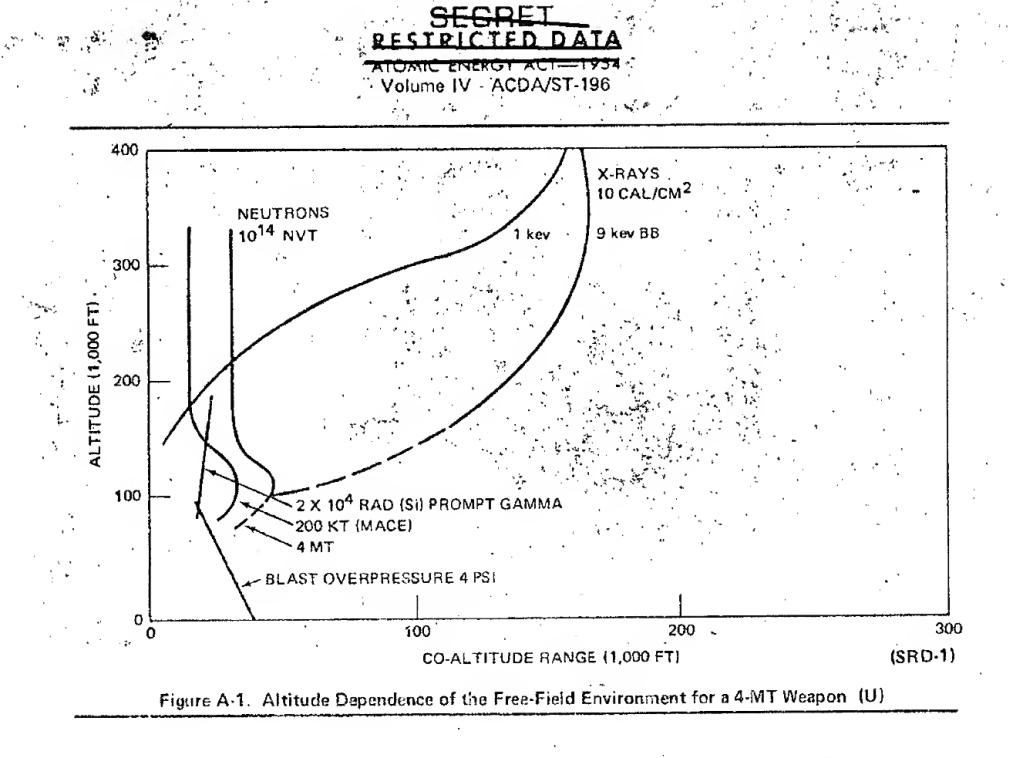
Figure 1 — Output for a 4 Mt weapon and Mace vs altitude.
We will get back to this in a few moments.
The second report is “Thermal Phenomena in the Fireball”, August 1963 (General Atomics).[2] The report explicitly states that it is discussing a 200kt device[2, p. 2] and that the device was the XW-50-Y2.[2, p. 17] The report itself mostly focuses on x-rays from the device and the hydrodynamic environment i.e. pressure and shockwaves.
From my personal understanding of US declassification guidance (the actual guides declassifiers use are themselves classified), I do not believe either of these documents should have been declassified as they have been. Almost all other documents that I have seen that describe weapon outputs in any detail redact those details. The same goes for documents discussing weapon system vulnerability to weapon effects. A good example of this is the Los Alamos report “Output for the Sprint Warhead”,[3] which consists of a heavily redacted introduction, a partially redacted description of Sprint, and then 20 pages of almost entirely redactions. That said, I do not believe that this data — which applies to very early Minuteman III missiles and earlier systems — has any significant bearing on modern US nuclear systems and is just another example of overzealous declassification policy.
And if it does, it’s too late: These have been available online for years and Pandora cannot simply close her box.
Output Data
The graph in the McDonnell Douglas report provides output data for two weapons: an unnamed 4 Mt device, and a 200 kt Mace device. For Mace, only neutron output is provided, and for the 4 Mt device, x-ray, gamma and blast data is also given. On the vertical axis is height of detonation, and on the horizontal axis is the distance from the burst where the affect takes place, which assumes that the detonation and target warhead are co-altitude i.e. at the same altitude as each other.
Some interesting things can be seen in this graph.
Neutrons
Important to the analysis I will make here for Mace and the 4 Mt device is “NVT”. NVT is an antiquated way to describe total neutrons over an area irrespective of time, and has units of neutrons per cm2.[4]
There is an interesting dog-leg shape to the neutron lines for both weapons at around 100,000 ft altitude. I do not have a conclusive explanation for this, but I believe it is caused by a process known as photodisintegration (which should not be confused with a similar process known as photofission). In photodisintegration a nucleus absorbs a gamma ray, which causes the atom to enter an excited state, before spitting out various subatomic particles as it decays. A candidate process would be photodisintegration of nitrogen-14, which forms nitrogen-13 and a neutron. The neutron energy peak for this process is in the 1.9 MeV to 2.6 MeV range, but does produce neutrons up to at least 12 MeV.[5]
This process would explain why above approximately 175,000 ft where the atmosphere is almost non-existent the neutron line straightens out, but as the atmosphere gets thicker the neutron dose increases, before decreasing again as the atmosphere gets too thick and starts absorbing neutrons. I do not believe that is process causing this dog leg could be photofission as photofission is a process that fissions heavy fissile elements, and as the only source of heavy elements is the nuclear device itself, the neutron output from the process would not change with altitude and therefore there should be no dog-leg shape.
From the graph, it may be possible to prove that the dog-leg is photodisintegration. The process to confirm this would involve running a Monte Carlo (MC) radiation transport simulation using the known composition of the atmosphere at altitude and gamma output lines for the 4 Mt device, and comparing the output to the neutron line in the graph.
X-rays
The graph provides two x-ray lines: one for 1 keV x-rays and another for 9 keV “BB” x-rays.
BB almost certainly refers to blackbody x-rays. The fact that only the 9 keV line is described as being blackbody x-rays would suggest that the 1 keV line is dominated by another process. It could be that the 9 keV line is x-rays directly emitted by the radiation case of the device while the 1 keV line are x-rays reemitted from other weapon or flight hardware heated by the device detonation, but in that case the 1 keV line is still a blackbody process. But the distinction in the report is unclear, and I cannot give any confident answers here.
The fact that 9 keV x-rays dominate in the 100,000 ft to 400,000 ft range is not surprising. At low altitudes, x-rays are absorbed by the atmosphere. This absorption is why the double flash effect exists.[6] As the atmosphere thins, it becomes more transparent to x-rays, allowing transmission of higher energy x-rays until it thins enough that low energy x-rays can pass through.
Similar to the neutron dog leg, someone could make some assumptions about the blackbody source for this data and then verify this with an MC radiation transport simulation.
Gamma
Gamma rays primarily come from the fission or decay of an atomic nucleus, and therefore represent the fission yield of the nuclear device.
If we are assuming that the neutron dog-leg is caused by photodisintegration, and knowing that the process is no longer absorbing gamma rays from the device by the approximately 200,000 ft mark, we may be able to calculate the total gamma output of the device and hence its fission yield.
Teak, Orange and Fishbowl
The devices used in US high altitude tests are quite limited and are listed below:
| Device | Yield | Tests |
| W25 | 1.7 kt | Hardtack Yucca and Argus series |
| W39 | 4 Mt (sometimes given as 3.75 or 3.8 Mt) | Hardtack Teak and Orange |
| W49Y2 (W28Y5) | 1.45 Mt | Fishbowl Starfish Prime |
| W50Y2 | 200 kt | Fishbowl Bluegill Triple Prime and Kingfish |
| Unknown (W50 primary?) | 10 kt | Fishbowl Checkmate |
| W31 | 10 kt | Fishbowl Tightrope |
Note: Bluegill Triple Prime and Kingfish are often cited as being 400 kt, but as I showed here, the devices tested were actually the 200 kt version of the W50. The W49 device is a W28 warhead modified for use on ICBMs.
It is very clear from this that the unnamed 4 Mt device is the W39 (which I will refer to it as from now on), and that the Mace device is the W50Y2.
As I mentioned in my previous post on Mace, a Los Alamos device called Lasu is regularly mentioned in documents on anti-ballistic missile system. The device was a pre-moratorium device like the W39 and could be the name for the W39 secondary. But is it well established that the W39 was just an improved Mark 15 bomb, and that the Mk15 device was named Zombie.[7] Some possible explanations could be that Zombie was the name for the whole tested weapon and the secondary had its own name, or that the higher yield version of the secondary used in the W39 was renamed Lasu. Or it could be that Lasu is the secondary of another weapon, such as the W28 whose name is not currently publicly known.
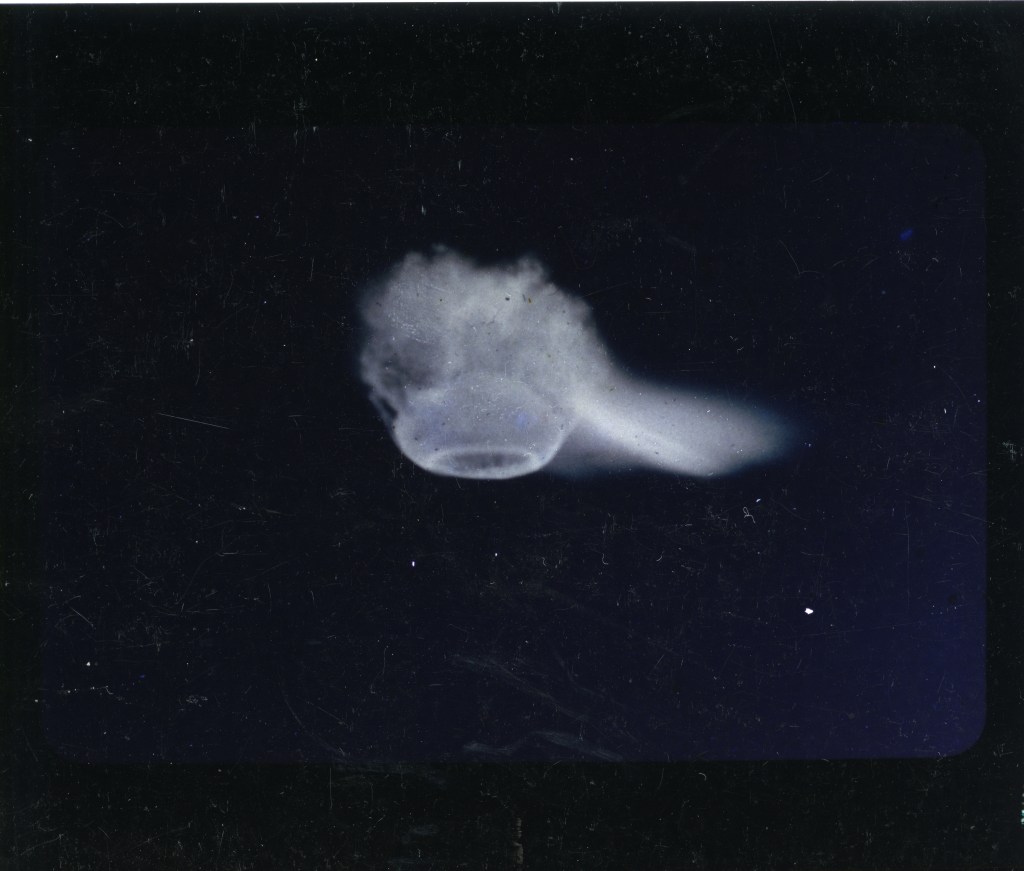
Figure 2 — Hardtack Orange (W39) fireball. Source: [8]
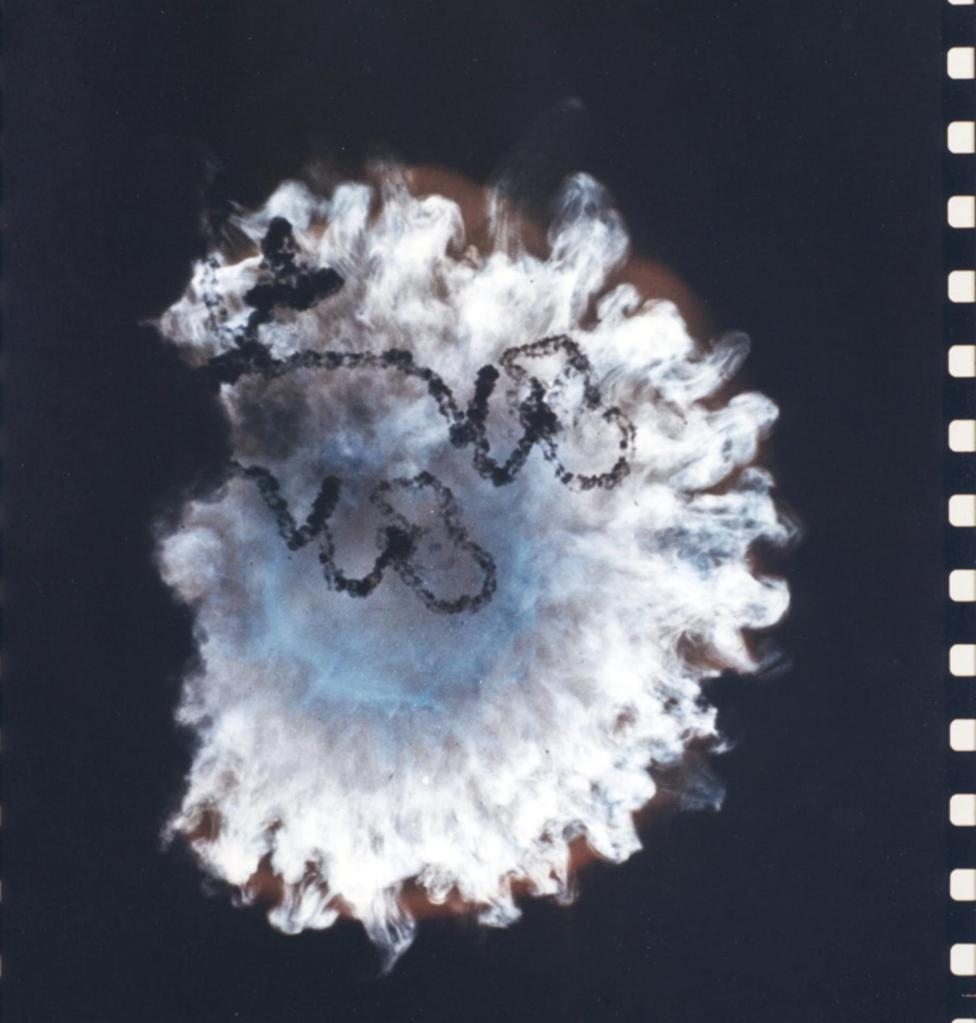
Figure 3 — Fishbowl Starfish Prime (W49Y2) fireball. The black squiggles are shadowing caused by the rocket engine exhaust. Source: US DoD or AEC.
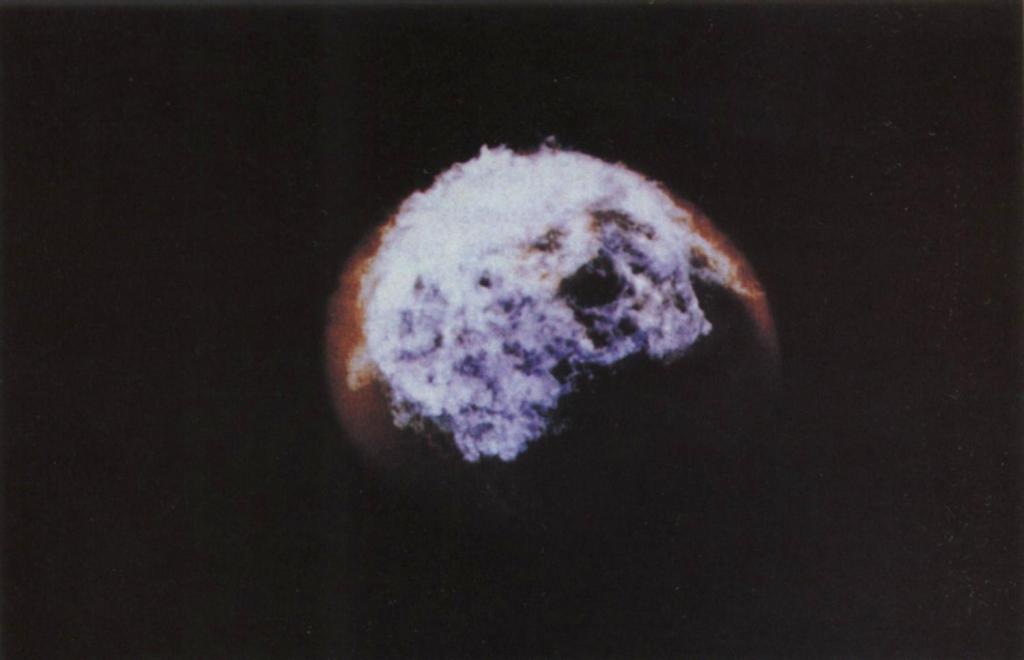
Figure 4 — Fishbowl Bluegill Triple Prime (W50Y2/Mace) fireball. Source: US DoD or AEC.
Yield from Neutrons
Using some reasonable assumptions, it is possible to infer information on the fusion and fission yields of both the W39 and Mace devices.
The Teller-Ulam Design
For quick reference, in most thermonuclear weapons the secondary (thermonuclear) stage is a sphere or cylinder consisting of a core of a fissile material (the spark plug — generally highly enriched uranium), a layer of lithium-6 deuteride (Li-6D — lithium hydride containing lithium-6 and deuterium isotopes instead of naturally occurring lithium and light hydrogen isotopes) which is the fusion fuel, and then an outer layer called the tamper, which can be made of a nuclear inert material such as lead or tungsten, or from a fissionable material such as various enrichments of uranium.
During detonation, the secondary is compressed by the x-ray heated ablation of the tamper. This compresses the fusion fuel to the densities required for fusion and compresses the spark plug to supercriticality. The spark plug produces heat as it fissions which heats the fusion fuel to fusion temperatures which causes D-D to fuse. The D-D fusion produces neutrons which fissions Li-6 into T and He-3. D-T fusion then takes over due to it’s much higher reaction rate compared to D-D fusion, heating the fusion fuel further and producing more neutrons to produce more T, which accelerates the fusion reaction. The extremely high neutron flux from the D-T reaction fissions almost entirely what is left of the fissile spark plug.
What happens next depends on the design of the device. If the tamper if made from a nuclear inert material such as lead or tungsten, the neutrons leave the device and deposit their energy into the device’s surroundings (the atmosphere or ground). If the tamper is made from something fissionable such as uranium, the neutrons will fission this material, producing more energy and fission products. As the tamper mass is the same across both types of devices, the use of a fissionable tamper allows for a higher yield for the same weight.
Devices with inert tampers are referred to as low-fission-fraction (clean) devices, while fissionable tamper devices are referred to as conventional (dirty) devices as the fission products from the tamper fission directly converts into nuclear fallout. It should also be noted that “clean” devices are not truly clean as fission products are still produced by the primary stage of the device and by the fissile spark plug. But the difference in fallout between clean and dirty devices is significant.
The issue of device cleanliness also has anti-ballistic missile implications, as fission products and gamma rays from fission can blind radars, making it more difficult for anti-ballistic missile systems to identify further targets.
Calculations
In a thermonuclear weapon, there are several nuclear reactions of note. The reactions and their energies are listed below.
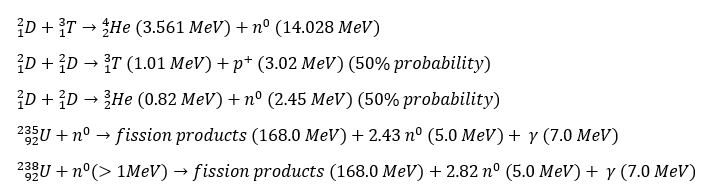
Sources: [9], [10]
Note: Total neutrons from fission reactions are averages. Delayed particles and neutrinos (and their energy) are disregarded. Data on total fission yield for fast fission of U-238 is hard to come by, but a 1989 Soviet report gives the total yield (excluding neutrinos) as 193.6 MeV for U-235 and 194.6 MeV for U-238, which are close enough for this analysis and therefore I have assumed identical energy yields for both U-235 and U-238 fission.[11]
As can be seen above, the total energy per fusion is significantly smaller than the total energy per fission. However, the mass of U-235 and U-238 are ~47 times more massive than for D-T, which on a mass basis means that D-T as a nuclear fuel contains 4.6 times as much energy as U-235. In practice the energy density is not as impressive as tritium is produced in-situ from Li-6, but it is still significantly greater than fission.
From the list of reactions, we can calculate the total neutron output per kiloton yield for the various fuels, listed below.
| Fuel | Neutrons per kiloton |
| D-T | 1.48*1024 |
| D-D | 3.58*1024 |
| U-235 | 3.53*1023 |
| U-238 | 4.09*1023 |
Assuming that at high altitude there are no secondary neutrons produced (neutrons produced from interactions with matter around the device at detonation), I measured from the graph the 1014 n/cm2 range to be 14,770 ft for Mace and 30,030 ft for the W39 device. Some simple maths gives the below total neutron yields for both devices assuming an even, spherical distribution.
| Mace | W39 device | |
| Radius (ft) | 14,770 | 30,030 |
| Radius (m) | 4,502 | 9,153 |
| Spherical surface area (m2) | 2.55*108 | 1.05*109 |
| Neutron yield | 2.55*1026 | 1.05*1027 |
The above numbers can then be used to calculate the total yields of each device, for each potential fuel. D-D fusion has been included as it starts the process of fissioning Li-6 to T in thermonuclear weapons, but the energy contribution is negligible and pure deuterium is unlikely to be used due to the need for cryogenic storage.
| Mace | W39 device | |||
| Fuel | Yield (%) | Yield (kt) | Yield (%) | Yield (kt) |
| D-T | 85.8% | 171.5 | 17.7% | 709.1 |
| D-D | 35.6% | 71.2 | 7.4% | 294.3 |
| U235 | 361.2% | 722.4 | 74.7% | 2986.2 |
| U238 | 311.2% | 622.5 | 64.3% | 2573.3 |
Mace
For Mace, it is clear that the yield must primarily come from nuclear fusion and therefore it is a low-fission-fraction device. For the given neutron output and for the yield to have come primarily from fission, the nuclear yield would have had to have been significantly higher than the 200 kt yield given.
The difference of approximately 30 kt between the known yield and calculated neutron yield will come from several sources. The first is that some of the yield must come from the primary stage and from the fission spark plug.
For the primary stage, basic fission principles tell us that criticality is achieved when for every fission, at least one of the neutrons produced goes on to fission another atom. For a system using U-235 as a fuel which produces 2.43 neutrons per fission on average, this means that one neutron goes on to fission another U-235 atom and 1.43 neutrons are absorbed by something non-fissile or escapes the pit. This state where one neutron goes onto fission another atom is referred to as k=1. But, in a nuclear weapon where large amounts of energy are released in microseconds, supercriticality (k>1) is needed, something like k=1.5 or higher
Let’s assume that the primary for Mace had a criticality of k=2 i.e. only 0.43 neutrons per fission escape, none are absorbed, and that the primary yield is 10 kt. The total neutron output for the primary is therefore 2.24*1022 neutrons, which is 0.244% of the total neutron output of the device. Therefore, the 10 kt of neutrons from fission of the primary are little more than a rounding error. The primary likely used a composite Pu-U instead of a HEU pit which has a slightly different average number of neutrons per fission, but this does not make the neutron contribution any less negligible.
The spark plug is very similar: a critical mass of some value for k, with the added factor of being surrounded by Li-6D. Deuterium is a neutron moderator and lithium-6 will absorb the neutrons and fission into T and He-3. It is likely that no appreciable amount of neutrons from the spark plug escape the secondary.
The other cause for the 30 kt difference will be D-T neutrons lost to the fission of Li-6 and neutrons lost to absorption by other materials in the device. With the information given, it is not possible to quantify what proportion is lost to these processes.
If we assume that the spark plug yield was 20 kt (i.e. that fusion neutron losses are insignificant and the primary yield was 10 kt), that the spark plug was made from HEU (energy value 17.74 kt/kg[12]) and that it underwent near complete fission, we can calculate the spark plug mass as 1.127 kg. This may seem too low given that the bare critical mass of HEU is ~50 kg, but the spark plug is heavily reflected by the fusion fuel around it, and calculations performed by Carey Sublette suggest that uranium densities of 290 g/cm3 (16.6x standard density) in first generation weapons like Ivy Mike were possible.[13] Given that Mace and the W50 were part of a generation of far more advanced weapons, it’s likely that even higher densities were achieved, and that a spark plug as small as this was pushed into supercriticality.
W39 Device
The W39 is a near opposite of Mace. The neutron yield assuming D-T fusion is a small fraction of the device’s actual yield, while the neutron yield assuming U-235 or U-238 fission is 1 to 1.5 Mt short of the actual yield.
Chuck Hansen in his book Swords of Armageddon lays out a convincing narrative for secondary in the Mark 15 bomb (named Zombie and which eventually became the W39) being a high fission fraction weapon. The system was a competitor to the 500 kt Mark 18 implosion bomb (which was of a similar weight), and is described as a two-stage fission-fission weapon.[14, pp. 343–346] The planned yield when a thermonuclear mock-up was tested in Upshot-Knothole Nancy was 500 kt.[14, p. 345] By the time of Operation Castle, yield was estimated at 1 to 2 Mt.[14, p. 348] Los Alamos director Norris Bradbury is quoted at this time stating that the “the thermonuclear field has been expanded to include the use of fissionable materials whose efficiency of utilization is materially increased by the use of thermonuclear techniques.”[14, pp. 347–348] The weapon was tested in Castle Nectar with a yield of 1.69 Mt.[14, p. 348] The improved TX-15-X1 with a yield of 3.8 Mt was tested in Redwing Lacross and the TX-15-X3 — a modification of the X1 with a new gas-boosted primary — was eventually renamed the W39.[14, p. 351]
My impression from this is that someone calculated the fissile material requirements for a two-stage megaton weapon using a small amount of fusion fuel and compared it with the Mark 18 bomb, and determined that in such a weight class, a two-stage device was more efficient without any significant weight increases over the Mark 18. Such a device would have a cost in fissile material in the primary, but the extra yield from fusion and fast fission of U-238, and much greater compression of U-235 in radiation implosion would make up for this loss. It also dodged the nuclear safing concerns found in the Mark 18 and the enormous amount of HEU required in the pit.[14, p. 343]
The two-stage system also likely carried advantages in HEU enrichment. A July 1954 meeting of the Atomic Energy Commission’s General Advisory Committee discusses the amounts of various nuclear materials that are needed for each weapon that was tested in Castle. Though the actual quantities are redacted, the headings make it clear that the weapons used combinations of 93.5% HEU and 37.5% HEU.[15, p. 18] The use of 37.5% HEU over 93.5% HEU would reduce the amount of separative work units (SWUs— a dimensionless unit that allows direct comparison of the work required to enrich uranium regardless of the starting, tails and heads enrichment) required and in turn reduce cost of the weapons.
Another detail supporting the notion that the W39 was a high-fission-fraction device is the yield of the low-yield version of the weapon (something I previously covered here). A classified report from the Director of Central Intelligence to the Joint Chiefs of Staff states that the yield of a warhead for the Redstone missile using pre-1958 technology is 425 or 3800 kt.[16, p. 21] The W39 is the only warhead Redstone ever carried and therefore we can assume that the low-yield version of the weapon was 425 kt.
The above narrative paints a convincing picture for the W39 being a high-fission-fraction device. The low-yield device likely used an inert tamper with the 425 kt yield coming from the primary, spark plug and fusion fuel. Perhaps something like 25 kt primary yield, 100 kt spark plug yield and the balance from fusion. In the high yield version, the primary, spark plug and fusion yields are likely the same, with the remaining ~3,500 kt coming from fission of the tamper.
One way to test this is to perform some calculations to see if 300 kt of Li6D fusion produces enough neutrons to fission 3,500 kt of U235. D-T fusion generates 1.48*1024 neutrons per kiloton. For 300 kt total fusion, the fusion neutron yield is 4.44*1026. Each U-235 fission produces 180 MeV or 2.88*10-11 J. If we assume that every neutron fissions a U-235 atom, we get a total of 3,060 kt.
This may seem slightly short of the ~3,500 kt required, but we have only discussed fusion neutrons so far. Each of these U-235 fissions produces 2.43 additional neutrons. The configuration of the tamper is not ideal for a chain reaction as it must be k<1 during storage, transport and delivery (and may not even reach k>1 during detonation and implosion) but we don’t need very many of the neutrons to not escape to get this little bit of extra yield.
If we are aiming for another 500 kt, then only 6.72% of the U-235 neutrons produced need to fission more U-235 in the tamper, and this 500 kt figure factors into our neutron data very neatly.
The bulk of the neutrons produced by the primary, spark plug and fusion fuel — producing 425 kt — will not escape the device. Most of the primary neutrons are reflected back into the pit, the spark plug is surrounded by Li-6D which reflects and also absorbs neutrons, and all of the fusion neutrons are captured by the tamper. Then 3,060 kt of U-235 neutrons are produced as the tamper is fast fissioned. 6.72% of these neutrons — 205 kt of U-235 fission worth — does not escape and fissions another 500 kt of U235, for a balance of 3,354 kt of fission neutrons.
We can put this in a table showing our neutron accounting.
| Source | Kilotons of neutrons produced | Kilotons of neutrons consumed | Kilotons of neutrons escaped |
| Primary, spark plug and D-T fusion | 425 | 425 | 0 (or close to it) |
| D-T neutron fission of tamper | 3,060 | 205 | 2855 |
| U-235 neutron fission of tamper | 500 | 0 | 500 |
| Total | 3985 | 630 | 3355 |
The total yield of 3,985 kt is absurdly close to the 4 Mt figure quoted, while the figure for yield from neutrons calculated escaping the device of 3,355 kt is only 12.3% off the actual figure of 2,986.2 kt. This discrepancy is easily explained by neutrons being absorbed by things such as the bomb casing or the limitations of pulling numbers from a graph from a report.
For the sake of completeness, I will note one counter point to this W39 narrative which is that hypothetically they could have designed a low-fission-fraction device and intentionally surrounded it with neutron absorbing materials such as boron-10 to reduce neutron output. This goes against all of the other information available on the Mark 15 and W39 devices, but it is technically possible.
Other Neutron Data
As noted earlier, output data for nuclear weapons is normally a closely guarded secret. The only significant exception is data from very early weapons such as Fat Man and Little Boy, and a few official reports intended for casualty modelling. The most recent data set for casualty modelling that I could find was from the 2017 and published by the Defense Threat Reduction Agency (DTRA).[17]
The official data is startlingly different from the output data calculated here.
| Factor difference | ||||
| Source spectra | Source | Neutrons per kiloton | W39 | Mace |
| Little Boy | White, Whalen & Heath 2001 | 1.07E+23 | 2.47 | 11.96 |
| Fat Man | White, Whalen & Heath 2001 | 1.59E+23 | 1.66 | 8.01 |
| APRD reactor | Glasstone & Dolan 1977 | 7.76E+22 | 3.39 | 16.41 |
| Glasstone (Fission) | Glasstone & Dolan 1977 | 7.76E+22 | 3.39 | 16.41 |
| Terrell | Glasstone & Dolan 1977 | 7.76E+22 | 3.39 | 16.41 |
| DNA 4267F (EM-1 Fission) | Gritzner, et al. 1976 | 1.00E+23 | 2.63 | 12.73 |
| Glasstone (Thermonuclear) | Glasstone & Dolan 1977 | 1.45E+23 | 1.82 | 8.81 |
| ORNL-TM-11775 (Boosted Fission) | Barnes, et al. 1991 | 3.10E+23 | 0.85 | 4.11 |
| ORNL-TM-3396 (High Yield Thermonuclear) | Glasstone & Dolan 1977 | 1.45E+23 | 1.82 | 8.81 |
| ORNL-TM-3396 (Intermediate Yield Thermonuclear) | Glasstone & Dolan 1977 | 1.45E+23 | 1.82 | 8.81 |
| ORNL-TM-3396 (Low Yield Thermonuclear) | Glasstone & Dolan 1977 | 1.45E+23 | 1.82 | 8.81 |
| DNA 4267F (Low Yield Thermonuclear) | Gritzner, et al. 1976 | 2.00E+23 | 1.32 | 6.37 |
| DNA 4276F (Henre) | Gritzner, et al. 1976 | 1.00E+24 | 0.26 | 1.27 |
Note: a factor difference < 1 indicates that the official neutron output is larger than the values calculated here.
First off, almost all of the official numbers come in under the Mace and W39 output data, and do so by a significant amount. Some of these are explainable as they are neutron outputs for fission devices and not thermonuclear devices. Except that the second closest match — ORNL-TM-11775 — is a boosted fission device. The closest match to W39 and Mace is DNA 4276F Henre, which was an experiment conducted at the Nevada Test Site in 1967 using a D-T neutron source on a tower.[18]
The W39 device is likely a good stand in for modern, compact and high-yield ICBM and SLBM warheads. Devices like the W88/Mk5 Trident II warhead likely rely on a high-fission-fraction to produce most of their yield, and it is safe to assume that the ICBM and SLBM warheads of other nations are similar in design due to the desire to maximise yield within a given size and weight envelope. At the other end of the scale, Mace is likely a good stand in for many tactical nuclear weapons as it is a low-fission-fraction design which is a very desirable feature in a tactical environment where fallout could be blown onto your own soldiers and civilians.
Given that this data set is likely used by public health officials for disaster planning and by scientists to perform casualty modelling, it seems negligent that the official figures are so far off from the neutron output figures calculated here. A neutron output figure I will add that used only the most conservative of assumptions in their calculation.
Conclusion and Further Work
From the analysis above, it is clear that the Mace device is the secondary for the W50Y2 warhead, and that it was a low-fission-fraction device. From some conservative assumptions, the fission yield is calculated at approximately 15%. The W39 device is in stark contrast, deriving approximately 92% of its total yield from fission.
In the future I plan to write a follow up looking at the gamma output for the W39 device and will attempt to use this gamma output data to further validate the high fission fraction I have calculated here from neutron output. A longer-term plan is to analyse the x-ray output data for Mace to determine if the output is representative of the whole warhead as the blackbody, or if the secondary itself is the primary blackbody.
References
[1] ‘Arms Control Implications of Strategic Offensive Weapon Systems – Vol IV: Technological Feasibility of launch-On-Warning and Flyout Under Attack’, McDonnell Douglas Astronautics, ACDA/ST-196, Jun. 1971. [Online]. Available: https://nsarchive.gwu.edu/sites/default/files/documents/6144719/National-Security-Archive-Doc-19-Aerospace.pdf
[2] B E Freeman, ‘Thermal Phenomena in the Fireball’, General Dynamics – General Atomics Division, GAMD-4468, Aug. 1963. [Online]. Available: https://apps.dtic.mil/sti/tr/pdf/AD0355863.pdf
[3] L C Harrison, W R Preeg, B B Rogers, J L Stokes, J R Lilley, and M Henderson, ‘Output for the Sprint Warhead’, Los Alamos National Lab. (LANL), Los Alamos, NM (United States), LA-6871-MS, Jul. 1977. Accessed: Feb. 14, 2026. [Online]. Available: https://www.osti.gov/opennet/detail?osti-id=1177118
[4] E. F. Laine, ‘RADIATION EFFECTS ON ELECTRONIC COMPONENTS.’, California Univ., Livermore. Lawrence Radiation Lab., UCID–4544, Jan. 1962. doi: 10.2172/4437968.
[5] C. Besnard-Vauterin, B. Rapp, and V. Blideanu, ‘New Measurements of Photoneutron Spectra investigating specific signatures of Carbon, Nitrogen, and Oxygen’, Radiat. Phys. Chem., vol. 229, p. 112566, Apr. 2025, doi: 10.1016/j.radphyschem.2025.112566.
[6] G. G. McDuff, ‘Effects of Nuclear Weapons’, Los Alamos National Lab. (LANL), Los Alamos, NM (United States), LA-UR-18-26906, Jul. 2018. doi: 10.2172/1463455.
[7] ‘Operation Castle’. Accessed: Feb. 14, 2026. [Online]. Available: https://nuclearweaponarchive.org/Usa/Tests/Castle.html
[8] Department of Defense. Defense Atomic Support Agency, Project 24 – Operation Hardtack (Enewetak/Bikini/Johnnston Island Area) Detonation. in Records of the Defense Threat Reduction Agency. Accessed: Mar. 09, 2026. [Online]. Available: https://catalog.archives.gov/id/146763744
[9] J. W. Sterbentz, ‘Q-value (MeV/fission) Determination for the Advanced Test Reactor’, Idaho National Lab. (INL), Idaho Falls, ID (United States), INL/EXT-13-29256, Oct. 2013. [Online]. Available: https://inldigitallibrary.inl.gov/sites/sti/sti/5842310.pdf
[10] ‘Nuclear Data for Safeguards’. Accessed: Mar. 09, 2026. [Online]. Available: https://www-nds.iaea.org/sgnucdat/a6.htm
[11] A. F. Badalov and V. I. Kopejkin, ‘Uranium and plutonium energy release per fission event in a nuclear reactor’, in Translation of selected papers published in Nuclear Constants 2, 1988, 1989, pp. 37–45. Accessed: Mar. 09, 2026. [Online]. Available: https://inis.iaea.org/records/2c11w-h7h06
[12] Carey Sublette, ‘Section 12.0 Useful Tables’, Nuclear Weapons Archive. Accessed: Mar. 09, 2026. [Online]. Available: https://nuclearweaponarchive.org/Nwfaq/Nfaq12.html
[13] Carey Sublette, ‘4.4 Elements of Thermonuclear Weapon Design’, Nuclear Weapons Archive. Accessed: Mar. 09, 2026. [Online]. Available: https://nuclearweaponarchive.org/Nwfaq/Nfaq4-4.html
[14] Chuck Hansen, Swords of Armageddon, vol. V, 7 vols. 2007.
[15] R W Dodson, ‘GAC TO AEC MEETING MINUTES NO. 41, DTD 7/12-15/54, SUBJECT: MISSILE APPLICATIONS; WEAPONS EFFECTS; REVIEW OF CASTLE; TACTICAL WEAPONS; NUCLEAR SAFEING; IMPROVEMENTS IN TH 30KT REGEION; ETC (DELETED)’, Atomic Energy Commission, AECGAC41, Jul. 1954. Accessed: Sep. 27, 2023. [Online]. Available: https://www.osti.gov/opennet/detail?osti-id=16091554
[16] Director Central Intelligence, ‘DCI Briefing to Joint Chiefs of Staff’, 117940, Jul. 1963. [Online]. Available: https://commons.wikimedia.org/wiki/File:JCS_briefing_(July_30,_1963).pdf
[17] K. Kramer, T. Dant, A. Li, and K. Millage, ‘Publicly Released Prompt Radiation Spectra Suitable for Nuclear Detonation Simulations’, Defense Threat Reduction Agency, DTRA-TR-17-026, Mar. 2017. [Online]. Available: https://www.deepspace.ucsb.edu/wp-content/uploads/2025/04/Publically-Released-Prompt-Neutron-spectra-for-NED-Simulation-DTRA-2017.pdf
[18] J. H. Thorngate, D. R. Johnson, and P. T. Perdue, ‘Energy and Angular Distribution of Neutrons and Gamma Rays – Operation HENRE’.
 Super Octopus