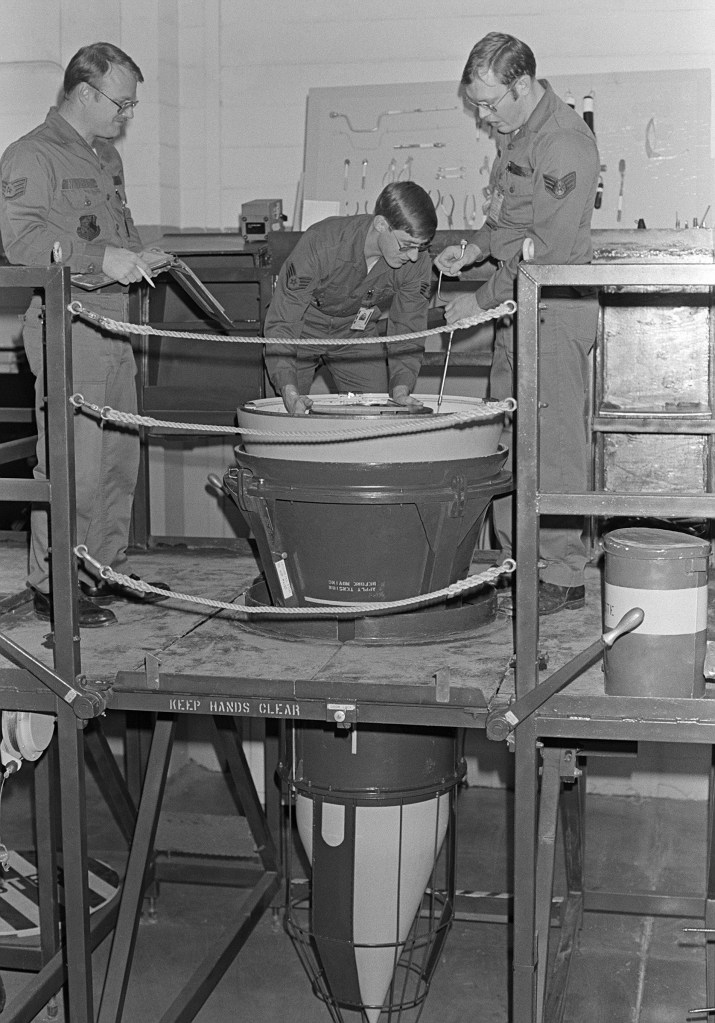
In 2006, a number of articles started making the rounds online regarding a safety incident at the Pantex Plant north of Amarillo, Texas in 2005. Pantex is today the sole assembly and disassembly plant for the United States’ nuclear weapons and was the primary assembly and disassembly location during the Cold War.
The news started with a December 2006 letter from the Project On Government Oversight (POGO) which alleged that in March 2005 there was a “near-miss” event while disassembling a W56 Minuteman II warhead. The letter alleged that technicians used a faulty tool which put too much pressure on a warhead and states that it “could actually have resulted in the detonation of the warhead”.[1] the letter does not specify if they are referring to a nuclear detonation, or if they are referring to detonation of the high explosives (HE) in the warhead.
This story was then picked up by The New Republic[2] and Los Angeles Times.[3] The LA Times article explicitly does say “accidental nuclear detonation” as a possible outcome.
Jeffrey Lewis for Arms Control Wonk added some sanity back into the discussion, explaining how all US weapons are one-point safe and that accidental detonation of the weapon’s HE would not produce significant nuclear yield. Though he rightfully adds at the end that the detonation of the HE would kill everyone working on the warhead, contaminate the cell with plutonium and erode confidence in Pantex’s ability to disassemble nuclear weapons.[4]
A quick History of the W56 Warhead
The W56 started life in 1958 with a design requirement for two different warheads for the then-in-development Minuteman system: a 330 lb (150 kg) warhead and a 550 lb (250 kg) warhead. The 550 lb warhead requirement that became the W56 was thought to be achievable by reworking the W47 Polaris A1 warhead.[5, pp. 8–9] In 1959 the design requirements firmed up, specifying a maximum weight of 600 lb with the requirement for the highest possible yield achievable in that weight class.[5, p. 10]
Lawrence Radiation Laboratory (LRL — later renamed several times before being renamed Lawrence Livermore National Laboratory) was assigned design responsibility,[5, p. 11] and two development names XW56 and XW56-X1 were assigned to the program.[5, p. 5] As there was a nuclear testing moratorium at the time, the XW56 would be the tested and proven design for initial deployment and the XW56-X1 would be the more radical and untested design that would be deployed when it became available.[5, p. 15] This likely meant that the XW56 was a near copy of the W47.
But by 1960, Minuteman’s production schedule had slipped, so it was unclear if the interim XW56 design would be needed.[5, pp. 15–16] The XW56 was then cancelled leaving the XW56-X1 to become the production W56.[5, p. 5]
The warhead used the Starling primary stage,[6, p. 15] which is generally believed to have been derived from the Los Alamos Tsetse device. Some phrasing in Sandia’s “History of the Mark 56 Warhead” appears to support this notion.[5, p. 17]
The secondary was the Fife device,[6, p. 15] with a yield of 1.2 Mt.[7, p. 337] This secondary was also adapted to the W47 warhead to make the W47Y2 warhead.[6, p. 15] Probable W56 tests include Dominic Arkansas and Dominic Bluestone.[8, pp. 404–405]
Minuteman II and its warheads were retired starting in 1992 and by 1995 all Minuteman II missiles were deactivated.[9, p. 100] The last W56 warhead was dismantled in 2006.[10]
Earlier Incidents
The POGO report identifies an earlier 2004 incident involving a W56 warhead. A 10th September 2004 report from the Defense Nuclear Facilities Safety Board confirms that there was a W56 incident involving cracked HE, but does not specify when it was.[11] Going through all weekly DNFSB reports from the start of 2004 for Pantex, I have identified one instance of HE cracking during disassembly, which occurred in mid-January.[12] The W56 is not explicitly mentioned, but given a lack of any other incidents of HE cracking 2004, it’s safe to assume that this is the incident referred to.
The weekly report describes the HE as being PBX-9404. PBX-9404 consists of by weight 94% HMX, 3% nitrocellulose and 3% tris(2-chloroethyl) phosphate.[13, Sects 3–6] One of the earliest high-energy plastic bonded explosives (PBX — not to be confused with plastic explosives) developed by Los Alamos, PBX-9404 was withdrawn from use due to several accidents and issues with the nitrocellulose component decomposing.[14]
The weekly report states that after cracking became apparent, Pantex staff taped the explosive to prevent further cracking, but the cracking expanded further until disassembly operations were halted. The affected dismantlement program was also halted.
An investigation report was released in early February.[15] The incident was attributed to several factors such as: “… the inadequate procedure used to tape the high explosives, the lack of training for personnel performing the procedure, and the absence of advisory personnel during the conduct of the procedure”. Pantex Site Office (PTXO) — the Department of Energy office that interfaces with BWXT, the contractor operating Pantex — criticised the PBX-9404 drop test data used in the report as not being suitable for evaluating cracked HE.
In the 19th March report, a proposed recovery plan was developed that involved “mummifying” the HE with tape.[16] The 16th July report describes new tooling being developed to prevent a reoccurrence of the incident.[17] The final report on the incident was released in early September 2004 which could not determine the actual cause of the cracking, but that it occurred around the time of the disassembly operation.[18] W56 disassembly operations resumed in mid-September.[19]
In May 2005, Pantex’s operator BWXT was fined USD$123,750 over the matter.[20]
The 2005 Incidents
As I will lay out, there were several incidents of note in 2005 at Pantex.
In mid-February, minor flaking and cracking was discovered during hydraulic separation of a main HE charge.[21] The following week’s report[22] states that:
“Operations in a nuclear explosive cell were suspended this week after production technicians discovered water leaking through a crack of the main charge high explosive during hydraulic separation. The separation normally occurs following pressurization along the equator, at a bonded joint. This fissure occurred at an o-ring/high explosive interface, approximately one half inch from the equator. BWXT is evaluating whether the slightly tilted configuration of the unit during disassembly or pressure applied by the o-ring to the HE (procedure warns against applying an excessive compressive force to the o-ring) may have contributed to the formation of the crack.”
This is an extremely interesting quote and seems to suggest that once removed from the implosion system, water is used to separate the two halves of the main HE charge from around the pit in this particular device. I can only assume that the rubber O-ring described must interface with the main HE at the pit-tube hole as this seems like it would be the only passageway into the HE charge.
The following week’s report describes technicians discovering that the cracked HE had separated as desired, simplifying disassembly of the device.[23] The 11th March report states that Los Alamos was advising on a path forward to resolve this issue which would strongly suggest this was a Los Alamos weapon.[24] BWXT staff are described as having stabilised the device in the following week’s report, with Los Alamos again advising.[25]
Going forward, I will refer to the device described above as “weapon A”.
In mid-March, a disassembly abnormality occurred where a cable was pulled out of a detonator during disassembly of another weapon (“weapon B”). The wording suggests that pulling on the cable was the proper procedure, but the amount of force to be used was not specified in the procedures. An alternative authorised removal process using a special tool may be used in future.[26]
On 30th March, another incident — a “disassembly abnormality” — occurred where HE separated at an unexpected location (“weapon C”).[27] The following week’s reports that weapon A was successfully disassembled and the parts packaged for examination. The weekly report also describes the weapon C incident as “… a component snapped and the tooling applied a force to a main charge in excess of the procedural limit”.[28]
The following week’s report describe Los Alamos as assisting with the weapon C incident. Another incident is described where the wrong piece of tooling was removed from a device (“weapon D”). The technicians upon recognising the error halted operations until a back-out procedure could be developed.[29]
In mid-April, a “small explosive component” began to separate while using an “alternative method” laid out in the procedures to remove it from a device. This sounds like a follow-up to weapon B’s issues with the cable separating from the detonator.[30]
This same report explicitly states that the weapon that underwent the “disassembly abnormality” — weapon C – was a W76 warhead.
The following week while attempting to recover from the weapon C situation, the disassembly technicians were unable to apply the required force to the weapon to separate the components as they reached the maximum point the tools and procedures would allow. The following day the technicians attempted the process again. When this did not work, the technician supervisor directed them to apply a sharp force to the tooling to separate the components. This applied 350 lb more that was permitted to the device. The staff were stood down over the event.[31]
In early May, a new disassembly cell was opened so that W76 disassembly could resume on other devices while weapon C occupied the normal cell.[32] Operations were halted less than 2 weeks later when technicians could not separate the re-entry body mid-case from another device (“weapon E”).[20]
In early June, it was discovered that the serial number of a weapon in storage did not match the number on the documents and the container. The wording seems to suggest that the error was the fault of the military and an investigation into location of the weapon that was supposed to be in the container was opened.[33]
A Nuclear Explosive Safety Change Evaluation (NCE) was convened to resolve the “sticking” W76 (weapon E). The NCE approved the use of a sylgard pump and higher level of force to remove the device from the mid-case.[34] The “sylgard pump” is not described, but sylgard is a name of several curable silicone-elastomer products. To engage in speculation, various sylgard materials are approved for use with HE, and some are quite viscous, perhaps allowing for the material to be pumped behind a part and hydraulically separate it?
Weapon E was finally separated from the mid-case in mid-July. The separation required injection of a “silicone-based substance” i.e. sylgard, and 3,400 lb of force.[35]
So Where is the W56?
The above makes it very clear that much of the safety issues in 2005 were related to the W76. But a letter from the chairman of the DNFSB to the deputy administrator for defense programs at the NNSA lays out that the incident where a piece of tooling was removed from a device — weapon D — involved a W56.[36]
Of all the incidents described above, this is perhaps the least concerning.
It is interesting how stories like these can so quickly and easily become muddled. Even more so given that the reports I cited have been available online for two decades.
Citations
[1] ‘POGO letter to DOE Secretary Bodman regarding serious safety problems at Pantex, a nuclear weapons assembly facility’. Accessed: Dec. 14, 2025. [Online]. Available: https://www.pogo.org/policy-letters/pogo-letter-to-doe-secretary-bodman-regarding-serious-safety-problems-at-pantex-a-nuclear-weapons-assembly-facility
[2] ‘Nuclear Near-misses’, The New Republic. Accessed: Dec. 14, 2025. [Online]. Available: https://newrepublic.com/article/36033/nuclear-near-misses
[3] Ralph Vartabedian, ‘Safety issues probed at Texas nuclear plant’, Los Angeles Times. Accessed: Dec. 14, 2025. [Online]. Available: https://www.latimes.com/archives/la-xpm-2006-dec-13-na-pantex13-story.html
[4] Jeffrey Lewis, ‘W56 Safety Problem?’ Accessed: Dec. 14, 2025. [Online]. Available: https://www.armscontrolwonk.com/archive/201326/w56-safety-problem/
[5] ‘History of the Mark 56 Warhead’, Sandia National Labs., Albuquerque, NM (USA), SC-M-68-48, Feb. 1968. [Online]. Available: https://osf.io/fcmta/
[6] Chuck Hansen, Swords of Armageddon, vol. V, 7 vols. 2007.
[7] Chuck Hansen, Swords of Armageddon, vol. VI, 7 vols. 2007.
[8] Chuck Hansen, Swords of Armageddon, vol. IV, 7 vols. 2007.
[9] ‘Minuteman Weapon System – History and Description’, TRW SYSTEMS GROUP REDONDO BEACH CA, July 2001. Accessed: June 27, 2022. [Online]. Available: https://minutemanmissile.com/documents/MinutemanWeaponSystemHistoryAndDescription.pdf
[10] ‘NNSA Dismantles Entire Stock of W56 Nuclear Weapons’, archive.md. Accessed: Dec. 22, 2025. [Online]. Available: https://archive.md/8J04s
[11] T. Hunt, ‘Pantex Plant Activity Report for Week Ending September 10, 2004’, Defense Nuclear Facilities Safety Board, Sept. 2004. [Online]. Available: https://www.dnfsb.gov/sites/default/files/document/5358/wr_20040910_34.pdf
[12] W. White, ‘Pantex Plant Activity Report for Week Ending January 16, 2004’, Defense Nuclear Facilities Safety Board, Jan. 2004. [Online]. Available: https://www.dnfsb.gov/sites/default/files/document/5324/wr_20040116_34.pdf
[13] B. M. Dobratz and P C Crawford, ‘LLNL explosives handbook: properties of chemical explosives and explosives and explosive simulants’, Lawrence Livermore National Lab., CA (USA), UCRL-52997-Chg.2, Jan. 1985. Accessed: July 18, 2022. [Online]. Available: https://www.osti.gov/biblio/6530310-llnl-explosives-handbook-properties-chemical-explosives-explosives-explosive-simulants
[14] C. E. Freye et al., ‘Identification of Blue Discoloration in PBX 9404 using Ultrahigh Pressure Liquid Chromatography with Quadrupole Time-of-Flight Mass Spectrometry’, Propellants Explos. Pyrotech., vol. 46, no. 3, Art. no. LA-UR-20-26938, Dec. 2020, doi: 10.1002/prep.202000230.
[15] W. White, ‘Pantex Plant Activity Report for Week Ending February 13, 2004’, Defense Nuclear Facilities Safety Board, Feb. 2004. [Online]. Available: https://www.dnfsb.gov/sites/default/files/document/5328/wr_20040213_34.pdf
[16] T. Hunt and W. White, ‘Pantex Plant Activity Report for Week Ending March 19, 2004’, Defense Nuclear Facilities Safety Board, Mar. 2004. [Online]. Available: https://www.dnfsb.gov/sites/default/files/document/5333/wr_20040319_34.pdf
[17] T. Hunt and W. White, ‘Pantex Plant Activity Report for Week Ending July 16, 2004’, Defense Nuclear Facilities Safety Board, July 2004. [Online]. Available: https://www.dnfsb.gov/sites/default/files/document/5350/wr_20040716_34.pdf
[18] T. Hunt, ‘Pantex Plant Activity Report for Week Ending September 10, 2004’, Defense Nuclear Facilities Safety Board, Sept. 2004. [Online]. Available: https://www.dnfsb.gov/sites/default/files/document/5358/wr_20040910_34.pdf
[19] T. Hunt, ‘Pantex Plant Activity Report for Week Ending September 24, 2004’, Defense Nuclear Facilities Safety Board, Sept. 2004. [Online]. Available: https://www.dnfsb.gov/sites/default/files/document/5360/wr_20040924_34.pdf
[20] T. Hunt and D. Kupferer, ‘Pantex Plant Activity Report for Week Ending May 20, 2005’, Defense Nuclear Facilities Safety Board, May 2005. [Online]. Available: https://www.dnfsb.gov/sites/default/files/document/4294/wr_20050520_34.pdf
[21] T. Hunt and D. Kupferer, ‘Pantex Plant Activity Report for Week Ending February 18, 2005’, Defense Nuclear Facilities Safety Board, Feb. 2005. [Online]. Available: https://www.dnfsb.gov/sites/default/files/document/4281/wr_20050218_34.pdf
[22] T. Hunt and D. Kupferer, ‘Pantex Plant Activity Report for Week Ending February 25, 2005’, Defense Nuclear Facilities Safety Board, Feb. 2005. [Online]. Available: https://www.dnfsb.gov/sites/default/files/document/4282/wr_20050225_34.pdf
[23] T. Hunt and D. Kupferer, ‘Pantex Plant Activity Report for Week Ending March 4, 2005’, Defense Nuclear Facilities Safety Board, Mar. 2005. [Online]. Available: https://www.dnfsb.gov/sites/default/files/document/4283/wr_20050304_34.pdf
[24] T. Hunt and D. Kupferer, ‘Pantex Plant Activity Report for Week Ending March 11, 2005’, Defense Nuclear Facilities Safety Board, Mar. 2005. [Online]. Available: https://www.dnfsb.gov/sites/default/files/document/4284/wr_20050311_34.pdf
[25] T. Hunt and D. Kupferer, ‘Pantex Plant Activity Report for Week Ending March 18, 2005’, Defense Nuclear Facilities Safety Board, Mar. 2005. [Online]. Available: https://www.dnfsb.gov/sites/default/files/document/4285/wr_20050318_34.pdf
[26] T. Hunt and D. Kupferer, ‘Pantex Plant Activity Report for Week Ending March 25, 2005’, Defense Nuclear Facilities Safety Board, Mar. 2005. [Online]. Available: https://www.dnfsb.gov/sites/default/files/document/4286/wr_20050325_34.pdf
[27] T. Hunt and D. Kupferer, ‘Pantex Plant Activity Report for Week Ending April 1, 2005’, Defense Nuclear Facilities Safety Board, Apr. 2005. [Online]. Available: https://www.dnfsb.gov/sites/default/files/document/4287/wr_20050401_34.pdf
[28] T. Hunt and D. Kupferer, ‘Pantex Plant Activity Report for Week Ending April 8, 2005’, Defense Nuclear Facilities Safety Board, Apr. 2005. [Online]. Available: https://www.dnfsb.gov/sites/default/files/document/4288/wr_20050408_34.pdf
[29] T. Hunt and D. Kupferer, ‘Pantex Plant Activity Report for Week Ending April 15, 2005’, Defense Nuclear Facilities Safety Board, Apr. 2005. [Online]. Available: https://www.dnfsb.gov/sites/default/files/document/4289/wr_20050415_34.pdf
[30] T. Hunt and D. Kupferer, ‘Pantex Plant Activity Report for Week Ending April 22, 2005’, Defense Nuclear Facilities Safety Board, Apr. 2005. [Online]. Available: https://www.dnfsb.gov/sites/default/files/document/4290/wr_20050422_34.pdf
[31] T. Hunt and D. Kupferer, ‘Pantex Plant Activity Report for Week Ending April 29, 2005’, Defense Nuclear Facilities Safety Board, Apr. 2005. [Online]. Available: https://www.dnfsb.gov/sites/default/files/document/4291/wr_20050429_34.pdf
[32] T. Hunt and D. Kupferer, ‘Pantex Plant Activity Report for Week Ending May 6, 2005’, Defense Nuclear Facilities Safety Board, May 2005. [Online]. Available: https://www.dnfsb.gov/sites/default/files/document/4292/wr_20050506_34.pdf
[33] T. Hunt and D. Kupferer, ‘Pantex Plant Activity Report for Week Ending June 3, 2005’, June 2005. [Online]. Available: https://www.dnfsb.gov/sites/default/files/document/4296/wr_20050603_34.pdf
[34] T. Hunt and D. Kupferer, ‘Pantex Plant Activity Report for Week Ending June 10, 2005’, June 2005. [Online]. Available: https://www.dnfsb.gov/sites/default/files/document/4297/wr_20050610_34.pdf
[35] T. Hunt and D. Kupferer, ‘Pantex Plant Activity Report for Week Ending June 22, 2005’, Defense Nuclear Facilities Safety Board, June 2005. [Online]. Available: https://www.dnfsb.gov/sites/default/files/document/4303/wr_20050722_34.pdf
[36] A. J. Eggenberger, V. Chainnan, J. F. Bader, J. E. Mansfield, and R. B. Matthews, ‘May 2, 2005, Board letter establishing a 30-day reporting requirement regarding NNSA’s path forward to improve conduct of operations at the Pantex Plant’. [Online]. Available: https://ehss.energy.gov/deprep/2005/FB05Y02A.PDF
 Super Octopus