I’ve been trying to put together a list of device codenames, determining what the devices are, what era they are from and then tying them to a lab. Of course, the holy grail is to identify what weapon they are associated with. I have listed some here with varying levels of certainty:
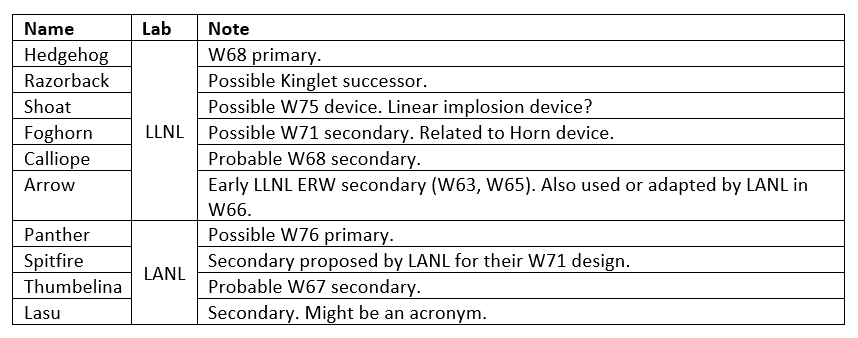
But the device that I have had some luck researching is Los Alamos’ Mace device, which I believe is the secondary for a large range of Los Alamos weapons. This includes the W50 Pershing I warhead, B61 bomb, W78 Minuteman III warhead. It also includes B61 derived weapons such as the W69 SRAM I warhead, W73 Condor warhead, and W85 Pershing II warhead. It is also possible that the Mace secondary was used on the W52 Sergeant warhead.
Coincidences
I have previously mentioned a collection of DASIAC search outputs found on OpenNet. There are eight in total (along with other miscellaneous DASIAC related reports), covering a period of 1940 to 1975, and describe reports with unclassified titles held by the Defense Nuclear Agency. Each result is listed with all of the usual things you would expect such as title, authors, date etc, but also included is the nuclear tests and devices discussed in the report (usually one or the other is redacted to obscure test-device associations), what is examined (weapon effects, weapon design etc) and lastly the nature of the nuclear tests discussed (high-altitude, low-altitude, underground etc).
Mace is perhaps the most named device. I have listed every mention I have found in DASIAC below:
H R Lehman, Wagner R L, W M Webster, W A Klickoff and R L Peurifoy, “Sure Kill of Reentry Vehicle Threats, Part 1, Neutrons”. Los Alamos Scientific Laboratory, Lawrence Radiation Laboratory, and Sandia Laboratories (September 1969). SC WD 69 418.[1, p. 103]
The report is on thermal radiation and neutron heating effects on reentry vehicles, and covers yield to mass (x-ray temperature) and thermal output of devices. The paper discusses the output total source intensity of the Mace, Robin B, Spitfire, Lasu and Arrow devices, but it’s possible that the source devices are also the target devices.
Robin B is likely mentioned due to the use of the W45 warhead on RIM-2 Terrier, which is believed to be a weaponised Robin design.[2, p. 14] Though not capable of destroying ballistic missiles, its inclusion may have been to act as a stand-in for a fission weapon armed missile in a similar size and weight class. Spitfire was Los Alamos’ Spartan warhead candidate.[3, p. V–57] Arrow is discussed in my post on the W62, XW63, XW65 and W70 warheads. It is not clear what Lasu is, other than it being a Los Alamos device, but based on the index of An Account of the Return to Nuclear Weapons Testing by the United States, where it mentioned alongside weapons like Mark 5 and Mark 7, and only received mention on a single page, it was probably developed and tested pre-moratorium.[4, p. 472]
“Closure Analysis and Test Study, Volume 8 — Criteria”. Ralph M Parsons Co (July 1969). SAMSO TR 69 213.[1, p. 124]
The report discusses x-ray, prompt gamma and neutron spectrums of Mace. This may be for a weapons effects test suggesting Mace was used as a source device in some test, but at this time they still used vertical line of sight tubes to get PINEX data from shots and these required closures on the tube used as it connected to the surface, so this is not guaranteed. TV PINEX was first used by Los Alamos in Crosstie Rickey, 15 July 1968.[3, p. III–31] It’s not clear when they moved over to the system entirely, thought I suspect it wasn’t until Baneberry.
R T Allen, “Energy Coupling for Mace, Topical Report”. Systems Science and Software (April 1970). DASA 2484.[1, p. 319]
The report discusses prompt neutron and x-ray outputs of Mace in relation to energy coupling with dry alluvium (a mineral comprised of volcanic debris that makes up most of the Nevada Test Site). The paper likely discusses underground nuclear testing.
P L Jessen and H J Price, “Nuclear Radiation Interactions with Optical Systems”. Kaman Nuclear (March 1968). KN 703 10 (R).[5, p. 252]
The report discusses nuclear weapon effects on metal alloys, test instruments and electronic parts (“solar cells”). Sources listed are the Horn, Arrow and Mace devices at low and high altitude (high altitude possibly means 30 to 100 km[6, p. 8]). Based on the dates and nature of the shots, this is likely comparing the Nike Zeus device (W50) with Safeguard (Spartan and Sprint) devices.
“Impact Study Shuttle System, Executive Summary, Appendix 1, Avionics and Survivability”. McDonnell Douglas Astronautics Co (March 1972). CDRL A003.[7, p. 61]
The document is on nuclear weapons effects on space systems (specifically the Space Shuttle system) and on animals, and includes EMP effects. Source is a high-altitude Mace device.
W A Coleman, E R Parkinson and C A Stevens, “X-Ray EMP Problems — Transport and Field Predictions”. Science Applications Inc (April 1974). DASA 2691, SAI 71 204 LJ.[7, p. 212]
Report covers nuclear weapon phenomenology (x-ray ionisation mechanisms) and radiation transport. Report includes x-ray output of Mace at surface level and low altitude.
J R Beyster, S A Dupress, D L Huffman and D A Sargis, “Neutrons and Gamma Radiation Emitted in Nuclear Explosions — Methods and Applications, Volume 4, Gamma Ray Output from the Mace and Tambourine Devices”. Science Applications Inc (May 1971). SAI 71 224 LJ IV, DNA 2927F4.[7, p. 241]
Report covers neutron and gamma outputs for Mace and Tambourine devices.
J D Cramer, H L Wilson, “Device Output and Radiation Environments for Underground Nuclear Tests”. Science Applications Inc (December 1972). SAI 71 234 LJ, DNA 3063F.[7, p. 255]
Report covers gamma, x-ray and neutron spectrum of the “Mace-9” and “Mace-11” devices in an underground test. It’s not clear if the number indicates which Mace test it is, or design variations on Mace. Primaries are normally given a sequential alphabetical identifier (i.e. Cougar A, Cougar B), while secondaries seem to use a numbering scheme based on Roman numerals (Fife I, Fife II), but development primaries also get numbers (Wildcat-10 for example), so it could be either, but my feeling is the former.
G Butler Jr, “Tactical Nuclear Weapons Environments Computer Code”. Kama Sciences Corp (November 1975). DNA 3891T, K 75 392 (R).[6, p. 294]
The report discusses thermal, neutron, blast pressure and gamma outputs of “Mace II”, including weapon effects on animals, at low altitude. The abstract is unusually included and states that:
“This report contains a description of a tactical nuclear ground effects computer code (TANGE) that has been developed to predict environments of prompt nuclear radiation, fission product gamma radiation, blast parameters, and thermal environments. Descriptions of the output from various generic type nuclear weapons having probable tactical application are included. Uncertainties in such calculations have been addressed.”
What can be drawn from these details?
Evidence of ABM use
“Sure Kill of Reentry Vehicle Threats, Part 1, Neutrons” suggests that Mace is either an ABM device or a suitable stand-in for a Soviet ICBM or SLBM warhead (i.e. a target device). It is mentioned here alongside other ABM devices such as Foghorn and Arrow.
“Nuclear Radiation Interactions with Optical Systems” again lists the device alongside other ABM devices, except there is no ambiguity as to which is the source and target devices. Optical devices may have been a technique considered in this era for discrimination of ABM targets.
“Impact Study Shuttle System, Executive Summary, Appendix 1, Avionics and Survivability” is unambiguously discussing an ABM weapon used against the Space Shuttle, based on it being a high-altitude device. The US Air Force was heavily involved in the Space Shuttle’s early development, so military applications were no-doubt considered.
The titles and descriptions of these three reports, in particular the latter report, make it clear that Mace was an ABM device. If we account for Arrow and Horn/Foghorn as being the W66 and W71 devices respectively, and considering that the W50 was the mainstay of American ABM devices in the 1960s, it’s reasonable to conclude that the device is the secondary for the W50 warhead.
Evidence of surface and low-altitude use
“X-Ray EMP Problems — Transport and Field Predictions” describes Mace being used at low altitude and in surface burst use while “Neutrons and Gamma Radiation Emitted in Nuclear Explosions — Methods and Applications, Volume 4, Gamma Ray Output from the Mace and Tambourine Devices” describes Mace and Tambourine being used at low altitude and in surface burst use.
Unfortunately, this does not prove that Mace was used in the B61 or W78 as the W50 was also used in Pershing I. In the case of Pershing, this might suggest that Tambourine (which uses Livermore naming) was a device for another tactical or theatre weapon, such as Lance. If that’s the case, Tambourine might be a Tuba successor or a low-fission-fraction Tuba. If Tambourine is a Tuba successor, it may also be the W62 secondary, which could support the notion of Mace being the W78 secondary, but I can not find evidence of this.
Better evidence of non-W50 use is found in “Tactical Nuclear Weapons Environments Computer Code”, which describes a Mace II device in 1975. This date fits the W78 and possibly B61 derived devices such as the W85 (such as a device modified to give 80 kt yield). Mace II may also describe the device modified to increase hardness to hostile weapon effects, something of concern for ICBM use.
Ambiguously, it uses the term “tactical environments”. This may indicate a tactical weapon, excluding the W78, but tactical is sometime used in the context of strategic systems. For example, some part of the Polaris missile was referred to as a “tactical unit” (I believe that this is the combined warhead, warhead bus and penaids).[8, p. 138] I suspect that this means something to do with the system’s local area it operates in, such as calling the weapon’s effects “tactical effects” (local effects), as it’s inappropriate to describe the weapon effects as “strategic effects” when strategic effects has a very different meaning more based in geopolitics and diplomacy.
None-the-less, this demonstrates that the Mace device was a long-running secondary with many varied applications.
Other Evidence
It is generally assumed that most or all modern American nuclear weapons use spherical secondaries. This may lead to questions as to if an old device like the W50 used one. If it did not, this would perhaps disprove the idea that the W50, B61 and W78 shared a secondary. However, explicit evidence of the W50 using a spherical secondary exists from a partially redacted test proposal list for Operation Dominic. It states that:
“This is a [redacted, one word] warhead for the [redacted, three or four lines] (This weapon was originally designed with a [redacted, two or three words] to relate more closely to a tested device, but a decision was made to go with a more efficient spherical secondary). The effects of there departures should be experimentally verified.”[9, p. 11]
In something of a waste of time, the device name and weapon system is redacted, even though Aztec was a test of a dirty version of the Adobe device used Nike Zeus, which is unredacted.
Interestingly, this seems to disprove the nation that Redwing Huron — a supposed early Nike Zeus warhead test — used a spherical secondary. Hansen alleges that this was the first spherical secondary tested by the US, predating the test of Tuba in Hardtack I Olive, but this makes it clear that the original XW-50 warhead did not use one. This change can be seen in the heavily redacted History of the Mark 50 Warhead where a new development device named XW50X1 is assigned to the weapon in around mid 1960, replacing the earlier XW50. This may be when the cylindrical secondary was replaced with a spherical secondary.[10, p. 15]
Other evidence can be found in the yields of each device.
| Weapon | Low (kt) | Mid (kt) | High (kt) |
| W50 | 60 kt | 200 | 400 |
| B61 | 50 | 170 | 340 |
| W78 | – | – | 335 to 350 |
These yields show similar patterns: the high yield B61 and the W78 have almost identical yields, while the three full yield options for the B61 are slightly below that of the three yields of the W50 variants. In fact, across all three B61 maximum yields, the percentage difference is 16.6% for the B61-4 and W50Y1, and 15% for the other B61 and W50 variants. Quite consistent.
It is possible that during miniaturisation of the B61 and W78, the designers were forced to compromise and use a slightly lower yield primary stage compared to Tsetse in the W50, reducing the secondary yield slightly across all three B61 variants consistently, and which very closely matches the drop seen in the W78.
Some other, weaker evidence comes in the form of a video title. In 2013 someone FOIA’ed a list of all films and videos held by the NNSA, one of which is titled “W78 / B61, Primary assembly (Animated)” and classified Secret RD.[11, p. 91] Obviously this explicitly describes a primary stage relationship, but other relationships between these two weapons might also exist. It would also explain why the high-yield B61 and W78 share a similar yield if they use the same primary and have the same primary yield.
Another note of interest is the W52 warhead for the Sergeant missile. In a 1962 declassified report which I discussed here, the W52 is described as having yields of 40 and 150 kt, similar to that mentioned previously. Further, if you examine Sandia’s History of the Mark 52 Warhead, you will find that the XW52X1 development name was assigned around the same time that the W50 received its own new XW50X1 name.[12, p. 4]
[Addendum: I somehow missed this line on page 13 of the W52 history: “Meanwhile, nuclear changes were pending, sparked by developments in other programs”, which lead to the new developmental name XW52X1 in May 1960.]
Conclusions
Though mostly coincidental evidence, there is a significant amount of it pointing towards Mace being the secondary device for the W50, B61 and W78. This theory fits a statement in Swords (and expands upon it) that says that the W50 and W78 share a secondary.
Modifications to the design would likely have had to have been made for use in both the B61 and W78. In the case of the B61, whatever mechanism is used for yield control may have required modifications to be made. For the W78, changes to improve hardening may have had to have been made which may explain the existence of Mace II.
Of the different Mace variants, the device used in the 200 kt W50Y2 was almost certainly a clean device (low fission-fraction device) given its planned use in the Nike Zeus ABM, and if the W50/B61 relationship is credible, the mid-yield B61 variants such as the B61-3 are probably also clean devices, which fits their tactical role. It is also probable that the low yield W50Y1 device used in Pershing I is also clean, which suggests that the low-yield B61-4 is also clean. The mechanism through which the yield is reduced is not known, but speculatively it may be through the use of lower-enrichment lithium-6 fusion fuel or through the use of a smaller spark plug (i.e. through reducing the temperature rise of the fusion fuel, therefore reducing the amount of fusion before disassembly).
The W50Y3; high yield B61 variants such as the B61-1, B61-7 and B61-11; and W78 are almost certainly dirty (high fission fraction) devices. The amount of fusion fuel they contain is probably similar to that of the mid-yield Mace device, but with a fissionable tamper. It is also possible that they use a very large spark plug which might explain why the lowest yield option (presumably using an unboosted primary) is 10 kt on the B61-7, with the small primary yield providing enough compression to turn the sparkplug supercriticality but not produce the pressures needed for significant fusion to take place.
If anyone has further details on Mace or any other device, email me at nuclear[the name of this blog with no spaces]@gmail.com
References
[1] ‘DASIAC PRINTOUT NO.5, 1967-1968, 857 CITATIONS (USING RADIATION OR RADIOLOGICAL)’, NV0754573, Jan. 1994. Accessed: Jun. 20, 2022. [Online]. Available: https://www.osti.gov/opennet/detail?osti-id=16388922
[2] Chuck Hansen, Swords of Armageddon, vol. V, 7 vols. 2007.
[3] Betty L Perkins, ‘Tracing the Origins of the W76: 1966-Spring 1973’, Los Alamos National Labs, LA-14066-H, Nov. 2003. Accessed: Jul. 23, 2021. [Online]. Available: http://blog.nuclearsecrecy.com/wp-content/uploads/2022/11/LA-14066-H.pdf
[4] William E Ogle, ‘An Account of the Return to Nuclear Weapons Testing by the United States After the Test Moratorium 1958-1961’, NVO291, Oct. 1985. Accessed: Jul. 16, 2021. [Online]. Available: https://www.osti.gov/opennet/detail?osti-id=16156584
[5] ‘DASIAC PRINTOUT NO.6, 1969-1970, 892 CITATION (USING RADIATION OR RADIOLOGICAL)’, DEFENSE NUCLEAR AGENCY, U.S. Accessed: Jul. 13, 2021. [Online]. Available: https://www.osti.gov/opennet/detail?osti-id=16388923
[6] ‘DASIAC PRINTOUT NO.8, 1973-1975, 919 CITATIONS (USING RADIATION OR RADIOLOGICAL)’, DEFENSE NUCLEAR AGENCY, Jan. 1994. Accessed: Jun. 20, 2022. [Online]. Available: https://www.osti.gov/opennet/detail?osti-id=16388925
[7] ‘DASIAC PRINTOUT NO.7, 1971-1972, 734 CITATIONS (USING RADIATION OR RADIOLOGICAL)’, Jan. 1994. Accessed: Jun. 20, 2022. [Online]. Available: https://www.osti.gov/opennet/detail?osti-id=16388924
[8] ‘Proceedings of the Special Projects Office, Task II – Monitor and Sponsor the Fleet Ballistic Missile Development Program, 37th Meeting, 21, 24 May 1963’, May 1963. Accessed: Jun. 15, 2022. [Online]. Available: https://nsarchive.files.wordpress.com/2015/02/proceedings-of-the-special-projects-office-task-ii-monitor-and-sponsor-the-fleet-ballistic-missile-development-program-37th-meeting-23-24-may-1963.pdf
[9] ‘Proposed Atmospheric Test Program’, Feb. 1962. Accessed: Aug. 12, 2022. [Online]. Available: https://www.proquest.com/dnsa/docview/1679112224/abstract/1324A85577D749C1PQ/15
[10] ‘History of the Mark 50 Warhead’, Sandia National Labs., Albuquerque, NM (USA), SC-M-67-682, Jan. 1968. [Online]. Available: https://osf.io/g3nsm/
[11] ‘Lists of motion picture films and videos at The National Nuclear Security Administration (NNSA), 2014’, p. 189.
[12] ‘History of the Mark 52 Warhead’, Sandia Corp., Albuquerque, N. Mex., SC-M-67-684, Jan. 1968. [Online]. Available: https://osf.io/eksvr
 Super Octopus
One response to “Mace, a Los Alamos Secondary Device”
[…] have previously written about the Los Alamos device named Mace, in which I made a strong case that Mace was a secondary […]
LikeLike