The UK’s Polaris program began after the cancellation of the US GAM-87 Skybolt air-launched ballistic missile in December 1962. The UK had intended to purchase the missile to be the backbone of their nuclear deterrent and the US cancellation of the system caused substantial diplomatic friction between the UK and US.
As a consolation, the US offered the UK the opportunity to purchase American made Polaris missiles instead, which was later agreed upon to be the multiple warhead A-3 version of the missile. But, for various reasons, it was decided that the UK would produce its own warheads for the missiles, the ET.317 warhead.
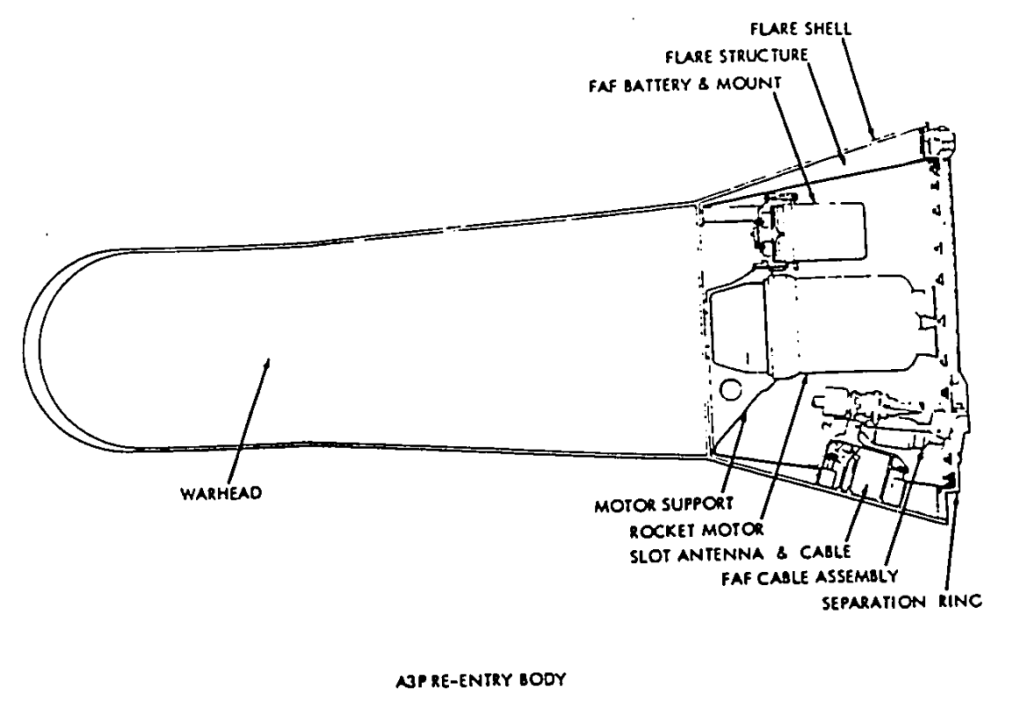
The Mark 2 Reentry Body (RB – US Navy parlance for a reentry vehicle). Source: [1, p. 133]
And here is where it becomes difficult for me to believe:
Commonly stated is that the UK anglicised the W59 warhead to make the RE.179 warhead for Skybolt, using the Simon secondary. The UK then modified this warhead slightly to produce the ET.317 warhead for Polaris, with the secondary renamed Reggie.[2][3] For those familiar with the respective weights and yields of this system, this probably raises a few eyebrows.
The US W59 weighed 550 lb (250 kg) and had a yield of 800 kt.[4, p. 20] The W58, the US’ Polaris A-3 warhead, weighed 257 lb (117 kg) and had a yield of 200 kt. The missile carried three W58 warheads. All of these weapons were highly optimised designs and there would have been no room for any significant weight trimming (bluntly, if the US could trim more weight, they would have). Further, the UK used American Mark 2 reentry bodies for their Polaris system, with the only domestically produced parts being the nuclear system and the arming, fuzing and firing system, so it had to fit inside the same space as the W58.[5, p. 107] So then, how did the UK put three, much larger 550 lb warheads in place of three 257 lb warheads, inside the same RBs and achieve the same range? It’s nonsense.
I have seen some attempt to explain this discrepancy, usually by describing the warhead as being modified in some way, but that seems like a substantial amount of work when the US had the W58 already tested and producing the exact same yield as the ET.317 warhead. Further there is no evidence of British testing of a supposed cut-down W59, which given how important the system was to British deterrence was probably necessary. It would be far more logical to just use the W58 warhead’s well tested secondary.
But there are some documents out there that suggest that ET.317 was derived from the W59, and I have some idea why: the W59 that they are referring to is actually the W58 warhead.
Strangely, this tale begins with the SADM or special atomic demolition munition. For those not familiar with the device, the US developed the W54 warhead for the AIM-26 Falcon air-to-air missile and for the Davy Crockett recoilless rifle, with a yield of 20 tons (yes, as in only 20,000 kg TNT equivalent). At only 10.9” (275 mm) in diameter, 15.7” (400 mm) in length and 50.9 lb (23.1 kg) in weight, the device was perfect for adaption into an atomic demolition munition (ADM), which they did adapt.[6]
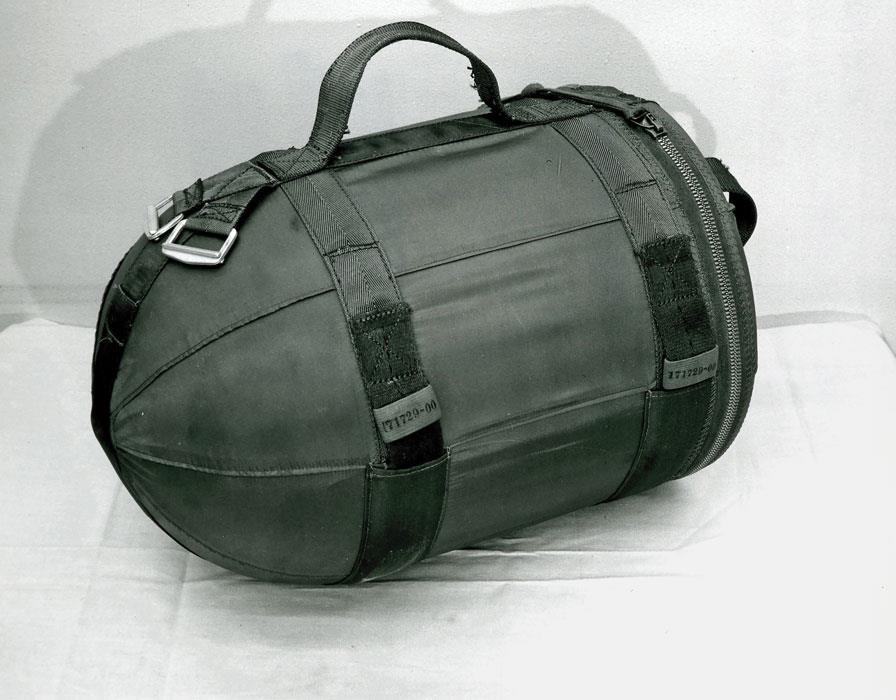
The B54 SADM in its carry bag. Source: [7]
Once modified for rough handling in the field and waterproofed for employment in various wet and less-wet locations, the SADM weighed 56 lb (25 kg) in the B54-0/1 versions. Slightly later a B54-2 version was produced which weighed 70 lb (32 kg). Speculatively, the B54-2 was probably a high yield boosted version of the weapon. Yields are classified, but were probably 10 t and 100 t unboosted, and 0.5 to 1 kt boosted, with yields set at the factory (i.e. they were non-variable).
However, in August and September of 1960 during development of SADM, there was some thought given to assigning the SADM to a new warhead number, such as TX-58, because the device was very different from the W54.[6, p. 18] It’s not clear on what basis it was “different enough” to potentially be reassigned; it might have been as simple as the fact its AF&F system was different, or the differences might have extended to the nuclear system of the weapon. I personally suspect the former, but there’s no evidence to support either way.
Ultimately, they decided to stick with calling SADM the B54, but this had follow-on effects. Notably, the Polaris cluster warhead was assigned the designation XW-59 before being reassigned to XW-58 in October 1960.[8, p. 8] The XW-59 designation was finally assigned to the 550 lb Minuteman warhead in January 1961.[9, p. 5]
Rather annoyingly, I can’t find the actual documents that say that the UK Polaris warhead was based on the W59. I recall having seen them on Brian Burnell’s nuclear weapons website (which is a great source for British nuclear weapon history and I have cited in this post), but after having spent several days looking through his site I have not been able to find them. I actually finished most of this post several months ago and having been holding off posting it until I could find the document, but now I’ve decided I will just update this post when I find them. None-the-less, I fully expect that the documents are either dated from around this time, or they are dated from sometime afterwards but that the name had not yet filtered through to the people at AWRE or the UK MoD.
This is not to say that the UK never used the W59 secondary (which some US documents call J-21). The evidence for the planned Skybolt warhead having been designed around it is quite firm and it’s very likely that the WE.177B thermonuclear gravity bomb used the W59’s secondary device.
If the W59 with a fissionable tamper produced 800 kt, it would be quite reasonable to think that a clean version of the secondary would produce the 450 kt that the WE.177B produced. The use of a clean weapon might have been because the British did not see the need for an 800 kt gravity bomb at that time or they were concerned that “sub-strategic” use of the weapon might have fallout concerns (such as when cratering Soviet airfields in East Germany or Poland). It might not even be a clean weapon: it might be that they substituted valuable HEU for cheaper natural or low enriched uranium, which reduced the yield.
A future post I am working on goes into the W59 in more detail. Though circumstantial, there is a large body of evidence that suggests that the W59 was derived from the B43 gravity bomb. Most of this relates to the same yields and that idea that the W59 was the tested and more conservative counterpart to the very radical W56 warhead. Interestingly, shot Dominic Encino (12 May 1962) was a test of a lower-yield variant of the B43 and produced a yield of 500 kt, quite close to that of the WE.177B’s 450 kt, and Encino’s yield appears to be rounded.
References
[1] ‘Proceedings of the Special Projects Office, Task II – Monitor and Sponsor the Fleet Ballistic Missile Development Program, 37th Meeting, 21, 24 May 1963’, May 1963. Accessed: Jun. 15, 2022. [Online]. Available: https://nsarchive.files.wordpress.com/2015/02/proceedings-of-the-special-projects-office-task-ii-monitor-and-sponsor-the-fleet-ballistic-missile-development-program-37th-meeting-23-24-may-1963.pdf
[2] Brian Burnell, ‘WE.177’, nuclear-weapons.info. http://www.nuclear-weapons.info/vw.htm#WE.177 (accessed May 31, 2022).
[3] ‘Britain’s Independent Deterrent’. https://www.armscontrolwonk.com/archive/202139/britains-independent-deterrent/ (accessed May 31, 2022).
[4] Director Central Intelligence, ‘DCI Briefing to Joint Chiefs of Staff’, 117940, Jul. 1963. [Online]. Available: https://commons.wikimedia.org/wiki/File:JCS_briefing_(July_30,_1963).pdf
[5] ‘Proceedings of the Special Projects Office, Task II – Monitor and Sponsor the Fleet Ballistic Missile Development Program, 43rd Meeting, 27, 28 May 1964’, May 1964. Accessed: Jun. 15, 2022. [Online]. Available: https://nsarchive.files.wordpress.com/2015/02/proceedings-of-the-special-projects-office-steering-task-group-task-ii-monitor-the-fleet-ballistic-missile-development-program-43rd-meeting-27-28-may-1964.pdf
[6] ‘History of the Mark 54 Weapon’, Sandia National Labs., Albuquerque, NM (USA), SC-M-67-686, Feb. 1968. [Online]. Available: https://osf.io/n6yrb
[7] G. G. McDuff, ‘Army Nukes’, Los Alamos National Lab. (LANL), Los Alamos, NM (United States), LA-UR-18-28012, Aug. 2018. doi: 10.2172/1467305.
[8] ‘History of the Mark 58 Warhead’, Sandia National Labs., Albuquerque, NM (USA), SC-M-68-50, Feb. 1968. [Online]. Available: https://osf.io/39nsr
[9] ‘History of the Mark 59 Warhead’, Sandia National Labs., Albuquerque, NM (USA), SC-M-68-51, Feb. 1968. [Online]. Available: https://osf.io/7j5qn/
 Super Octopus