Alex Wellerstein, who runs the blog Restricted Data and is well known for having created NUKEMAP, last year shared a few pages from document he obtained over on r/nuclearweapons. The document is DCI Briefing to Joint Chiefs of Staff dated 30th of July 1963 and marked top secret restricted data. It apparently came from someone else who FOIA’ed it, but I don’t see the usual declassification markings on the document. The document discusses US and Soviet state of the art in nuclear weapon yield to weight ratios. A number of juicy details can be found.
The first thing to note is that the US assessment of Soviet capabilities is completely ludicrous. For example, they estimate the Soviets have the capability to produce a 100 Mt weapon (which would be the Tsar bomb) which they estimated to weigh in at 11,300 kg (25,000 lb). In actuality, the Tsar bomb weighed 27,000 kg (60,000 lb).
To be fair, these numbers appear to be based on US estimate of ICBM throw weight. They’ve looked at Soviet ICBMs, estimated the throw weight and then guesstimated which warhead goes with each ICBM system. Obviously, they made the mistake of assuming every device is intended to be weaponizable as an ICBM warhead on in production and then-planned Soviet ICBMs. From the US perspective that might have made sense, but in reality, weapons like the Tsar bomb were showpieces. They appear to have based their numbers for high yield weapons around the Tsar bomb.
They go on to note that the US is superior in low yield and lightweight thermonuclear weapons, to the point where the Soviets appear to have no <600 lb (272 kg) thermonuclear weapons. They do note that their ability to detect low-yield tests is limited and they may have simply missed the tests, but history appears to have supported the notion that the Soviets didn’t have lightweight thermonuclear weapons until the 1970s. The Soviets were still using RN-40 tactical fission weapons in the 1980s.
There are several tables and graphs of importance in the document. Several are quite degraded and I have attempted to reconstruct them. I have chosen to retain the original units as much as I dislike using pounds and nautical miles.
********
Gains in Thermonuclear Warhead Yield to Weight Ratios Feasible to Stockpile from 1961-1962 Nuclear Tests
| Warhead weight class (lb) | kt/lb prior to 1961 | kt/lb after 1962 | ||
| US | USSR | US | USSR | |
| 100 | 0.1 | * | 1.0 | * |
| 200 | 0.9 | * | 1.3 | * |
| 400 | 1.1 | * | 1.5 | * |
| 600 | 2.0 (1) | 0.4 | 2.0 | 0.65 |
| 2,000 | 1.0 | 0.9 | 2.5 | 1.3 |
| 4,000 | 1.5 | 1.0 | 2.5 | 1.9 |
| 6,000 | 1.5 | 1.2 | 2.0 (2) | 2.3 |
| 10,000 | 2.3 | * | 2.3 (2) | 2.9 |
| 13,000 | * | * | * | 3.2 |
| 19,000 | * | * | * | 4.0 |
* – No modern developments in this weight class to date.
1 – Not actually demonstrated until 1962 tests.
2 – No additional tests contributing to stockpiling in these areas.
********
LANL reportedly tested a 100lb/100kt warhead design in Operation Nougat (the 100 kt/ 100 lb idea). This would seem to indicate they were successful.
The 600 lb warhead class is interesting as it seems to imply a 2kt/lb warhead like the W47Y2 was designed and possibly stockpiled before 1962. My understanding was that only the Y1 was stockpiled before 1962.
********
Approximate Maximum Distance at which Various Yields will Severely Damage Minuteman Silos
| Yield | Distance |
| 1.2 Mt | 0.43 mi |
| 9 Mt | 0.85 mi |
| 100 Mt | 1.9 mi |
********
Note, this was a graph but it was easier to recreate as a table.
Back calculating the overpressure at that distance using NUKEMAP, it’s possible to discover the hardness of early Minuteman silos was only 400 PSI. Modern estimates for Minuteman silos start at 3,000 PSI and go up to about 5,000 PSI. Some Russian silos are thought to be harder than 10,000 PSI.
********
High Altitude Test Experience
| US Experience | USSR Experience | ||
| 1958 | 1962 | 1961 | 1962 |
| Argus I (1.7 kt), 170 km | Starfish (1,400 kt), 400 km | Joe 105 (~1 kt), 300 km | Joe 160 (~200 kt), 350 km |
| Argus II (1.7 kt), 310 km | Checkmate (10 kt), 147.3 km | Joe 109 (~1 kt), 150 km | Joe 163 (~200 kt), 200 km |
| Argus III (1.7 kt), 794 km | Kingfish (200 kt), 97.2 km | Joe 98 (~200 kt), 30 km | Joe 172 (1,800 kt), 90 km |
| Teak (4,000 kt), 76.8 km | Bluegill (200 kt), 48.3 km | ||
| Orange (4,000 kt), 43 km | Tightrope (10 kt), 21 km |
********
Note, US altitude numbers were taken from elsewhere as they have been declassified. Due to poor image quality, Joe 172 may read as 1,300 kt instead of 1,800 kt.
The yields given for the Fishbowl shots (1962) are of particular note given that except for Starfish they are still classified. Hansen gives <5 kt for Checkmate and Tightrope and 400 kt for Bluegill and Kingfish. The 400 kt value likely comes from the maximum yield of the W50 warhead used. The other yields for the W50 were 60 and 200 kt.
********
US and USSR Nuclear Weapons Systems – 20 December 1962
| System | Range (n.m) | Warhead weight (lb) | Yield 1958, earlier | Yield 1961 and 62 | Yield future series |
| Intercontinental Ballistic Missiles | |||||
| Atlas D | 5,550 | 1,665 | 1,450 | 3,700 | 5,500 |
| Atlas E | 5,500 | 3,300 | 4,500 | 8,000 | 12,000 |
| Atlas F | 6,300 | 3,300 | 4,500 | 8,000 | 12,000 |
| Titan I | 5,500 | 3,300 | 4,500 | 8,000 | 12,000 |
| Titan II | 5,500 | 6,190 8,500 | 9,000 – | 10,000 – | 15,000 20,000-40,000 |
| Minuteman | 5,500-7500 | 550 600 750 | 800 1,200 – | – – 1,500 or 3x 250 | 1,200 1,300 2,250 or 3x 350 |
| SS-6 | 6,000 6,000 4,500 | 7,000 5,500 9,000 | 6,000 – – | – 10,000-13,000 20,000-24,000 | – – – |
| SS-7 | 6,000 6,000 | 3,000 ~3,500 | 3,000 – | – 5,000-5,800 | – – |
| SS-8 (if small) | 6,000 | ~3,500 | 3,000 | – | – |
| SS-8 (if large) | 6,000 | ~17,500 | – | 40,000-60,000 | – |
| Sub-Launched Ballistic Missiles | |||||
| Polaris A-1+2 | 1,500 1,200 | 717 717 | 500 1,200 | 1,500 1,500 | 2,250 2,250 |
| Polaris A3 | 2,500 – | 795 1,000 | 3x 200 – | 3x 250 2,000 | 3x 375 3,000 |
| SS-N-4 | 300 | 3,500 | 2,700 | 5,000-5,800 | – |
| SS-N-5 | 650 | 500 | – | 1,500 | – |
| Sub-Launched Cruise Missiles | |||||
| Regulus I | 500 | 2,800 | 1,900 | 6,000 | 9,000 |
| SS-N-3 | 300 | 2,200 | 10 to 1,500 | 3,000 | – |
| Air to Surface Missiles | |||||
| Hound Dog | 200-600 | 1,650 | 11 to 1,100 | 3,700 | 5,500 |
| AS-2 | 100 | 2,200 | 10 to 2,000 | 3,000 | – |
| AS-3 | 350 | 5,000 | 6,000 | 10,000-13,000 | – |
| AS-4 | Unknown | Unknown | – | – | – |
| Intermediate and Medium Ranged Ballistic Missiles | |||||
| Thor | 1,500 | 1,669 | 1,450 | 3,700 | 5,500 |
| Jupiter | 1,500 | 1,669 | 1,450 | 3,700 | 5,500 |
| ??? MRBM | 300-2,000 | 300 | – | 400 | 600 |
| SS-3 | 2,200 2,200 | 8,000 3,500 | 8,000 – | – 5,000-5,800 | – – |
| SS-4 | 1,020 | 2,200 | 150, 500, 1,500 and 2,000 | 3,000 | – |
| SS-5 | 630 | 2,200 | As above | 3,000 | – |
| Shorter Range Ballistic Guided Missiles | |||||
| Pershing | 400 | 395 | 40 and 440 | 600 | 900 |
| Redstone | 175 | 3300 | 425 & 3800 | 8000 | 12000 |
| Corporal | 75 | 1000 | 0.09 to 47 | 1800 | 2700 |
| Sergeant | “ | 950 | 40 & 150 | “ | “ |
| Lacrosse | 16 | 307 | 1.7 & 10 | 400 | 600 |
| SS-2 | 350 | ~3000 | 30 to 200 | – | – |
| SS-1a (?) | 90 | “ | 30 to 200 | – | – |
| SS-1b (?) | 150 | 1200 | “ | 850 | – |
| Land-Launched Cruise Missiles | |||||
| Mace | 1200 | 1650 | 11 to 1100 | 3700 | 5500 |
| SS-C-1 | 300 | 1000-2000 | Up to 1500 | – | – |
| Free Rockets | |||||
| Honest John | 21 | 902 | 2 & 30 | – | – |
| Little John | 10 | 151 | 1.7 & 10 | – | – |
| FROG-1 | 13 | 3000 | ~15 | – | – |
| FROG-2 | 10 | 1300 | “ | – | – |
| FROG-3 | 16 | 1200 | ~15 | – | – |
| FROG-4 | 22 | 700 | “ | – | – |
| Tube Artillery | |||||
| 280 mm Gun | 10 | 600 | 2 to 45 | – | – |
| 8” Howitzer | 8 | 243 | 1.9 | 10 | – |
| 175 mm Gun | 13.5-17 | 147-170 | – | – | 5-10 |
| ??? mm Howitzer | 26 | 118 | 0.8 | 1.3 | 2-5 |
| 155 mm AFAP | 6.9 | 130-140 | – | – | 2-8 |
| Davy Crockett | 2.2 | 60 | 0.02 | 0.1&5 | – |
| 105 mm (?) Howitzer | 2.9-4.7 | – | – | 0.02-0.4 | – |
| ??0 mm Mortar | 10 | 1700 | 5-30 | – | – |
| 280 mm Gun | 12 | 700 | “ | – | – |
| 203 mm Gun-How | 16 | 225 | ~2 | – | – |
| Surface-To-Air Missiles | |||||
| Nike Hercules | 80 | 902 | 2, 20 &30 | – | – |
| Talos-W | 800-100 | 455 | 2 | – | – |
| Terrier | 20 | 151 | 1.7 | – | – |
| Typhon | 200 | – | 10 | – | – |
| Nike Zeus | 75 | 395 | 200 | 600 | 900 |
| SA-1 | 20-25 | 300 | 5-25 | – | – |
| SA-2 | 20-25 | 300 | “ | – | – |
| SA-3 | Unknown | Unknown | – | – | – |
Other US nuclear weapons systems without identified USSR nuclear parallels
[illegible, something about SA-4 missile — nuclear SAM?]
[Something about nuclear depth bombs] — Torpedos reported
Atomic Demolition Munitions — No Soviet ADMs identified.
Tactical purpose bombs or pods — No Soviet counterparts identified.
*****
This is the best bit. One does need to recognise what numbers are actually deployed numbers and what are hypothetical. For this purpose, I am assuming weapons deployed by this point or in the final design stages are actual numbers while other numbers are hypothetical or assumed.
In mostly descending order. I will jump all over the place for warhead used across many systems:
- The 3,300 lb warhead for Atlas E and F and Titan I is generally reported as 3,800 kt, but here is listed as 4,500 kt.
- The 550 lb Minuteman warhead has a yield of 800 kt and the 600 lb warhead has a yield of 1,200 kt. The 550 lb warhead for Minuteman was the W59, generally reported as having a 1 Mt yield, not 800 kt. The 600 lb warhead is the W56, with its generally reported yield matching the actual.
- In the 750 lb warhead class, Minuteman is thought to be able to carry 3x 250 kt warheads. Though this report predates the W62, it likely gives us some idea as to the weight of the W62. NWA describes the W62 as 700-800 lb with RV and the warhead as 253 lb (this number is from Swords) I strongly doubt the warhead with RV weight is correct, but the warhead weight almost exactly matches the number given here. I suspect someone took 750 lb to mean the weight of each warhead and not the total weight of the warheads.
- Two 717 lb warheads for Polaris A1 and A2 are given, one with 500 kt and the other 1,200 kt, presumably the Y1 and Y2 versions of the W47 respectively. This report post-dates the full-scale system test of the W47 Y1 (Dominic Frigate Bird) whose yield is normally given as 600 kt, not 500 kt. Perhaps this is a matter of yield uncertainty?
- Polaris A3 is given as 795 lb total weight for 3x 200 kt warheads. The W58’s weight is normally quoted as 257 lb.
- The W27 warhead for the Regulus cruise missile is 1,900 kt. The yield is normally given as 2 Mt.
- The W28 warhead for the Hound Dog and Mace cruise missiles is given as 11 to 1,100 kt. It has previously been suggested that the Y4 yield might have been a fission-only device and 11 kt fits for that role. Some W28 yields never entered production and it’s likely the Y4 is one example.
- Pershing’s warhead was tested before this report, but the yield of the W50 warhead is given as 40 and 440 kt. This is unusual as the W50s yields of 60, 200 and 400 kt are thought to be quite accurate (though looking at Swords, Hansen uses both 400 kt and 440 kt as the upper W50 yield). Further, the W50 was used in some of the high-altitude tests described above, and 200 kt is not one of the yields given. Pershing was apparently introduced into service in 1962, but History of the Mark 50 Warhead makes it clear production of the W50 did not begin until March 1963.[1] It’s possible the 200 kt warhead was not planned for stockpiling for Pershing at the time (or never was), and that the 40 and 440 kt yields were untested and extrapolated from the Y2 warhead. Nike Zeus is listed further down as having an identical warhead weight but a yield of 200 kt.
- The W39 warhead used in Redstone is normally given as 3,800 kt, which matches one of the yields given. The other 425 kt yield however is very unusual. The weapon was reportedly produced in two yields, so 425 kt is possible, but is it very low. Perhaps this is the yield the warhead produces without a spark plug and with an inert tamper? Or perhaps there is no thermonuclear fuel and it’s entirely spark plug yield? The W39 was a modernised Mark 15.
- The W7 warhead used on the Corporal and Honest John missiles had yields of 0.09 to 47 kt, with yield options of 2 and 30 kt. The Nike Hercules also carried the W7, but I believe by this point it was carrying the W31 warhead.
- W40 warhead used in the Lacross and Bomarc missiles is given as having yield options of 1.7 and 10 kt.
- Little John and Terrier carried the W45 warhead. Given here, Little John used the 1.7 and 10 kt versions, while Terrier only used the 1.7 kt version.
- The W19 warhead for the 280 mm gun had yields of 2 to 45 kt.
- 243 lb is the exact weight of the W33 warhead for the 8” (203 mm) gun, meaning one of the yield options was 1.9 kt.
- I am uncertain what calibre it actually is, but a shell with a range of 26 nm (2.6 nm?) and a weight of 118 lb is given a yield of 0.8 kt. The W48 is sometimes described as weighing 118 lb, but it does not have a range approaching either 26 nm or 2.8 nm (actual range is 14 km or 7.5 nm). I suspect it may be a lightweight 175mm shell designed for extended range, but that is speculation on my part. The W48 was initially designed for the 175mm however, so that may be the origin of claims the W48 weighed 118 lb?
- The yield for the 155mm W48 AFAP is not given under current capabilities, and future yield is given as 2 to 8 kt. Actual yield was 0.07 kt.
- The W54 for Davy Crockett is given as 0.02 kt, matching the yield found here. Interestingly, yield for warheads developed in 1962 is given as 0.1 to 5 kt.
- I believe the howitzer given as having a range of 2.9 to 4.7 nm is the 105mm gun. Assuming a heavier than normal projectile would explain the short range, while the small diameter would constrain the yield to 0.02 to 0.4 kt.
- I have no idea what mortar would have a range of 10 nm and a shell weight of 1700 lb. That sounds slightly ridiculous. I wonder if it is a typo or something that was thought about but never developed?
- 203mm (8”) gun with a range of 16 nm, shell weight of 225 lb and 2 kt yield. This is probably plans for an implosion 203mm shell to repalce the gun-type W33.
- W30 for Talos had a yield of 2 kt.
There is another graph on page 17, plotting warhead weight to yield to weight ratios of various weapons. I spent a while straining my eyes over this and have managed to name most of the US points on the graph, while also adding a scale. The blue lines represent the weights of two well known weapons, the W56 and B41, and are used to calibrate the scale.
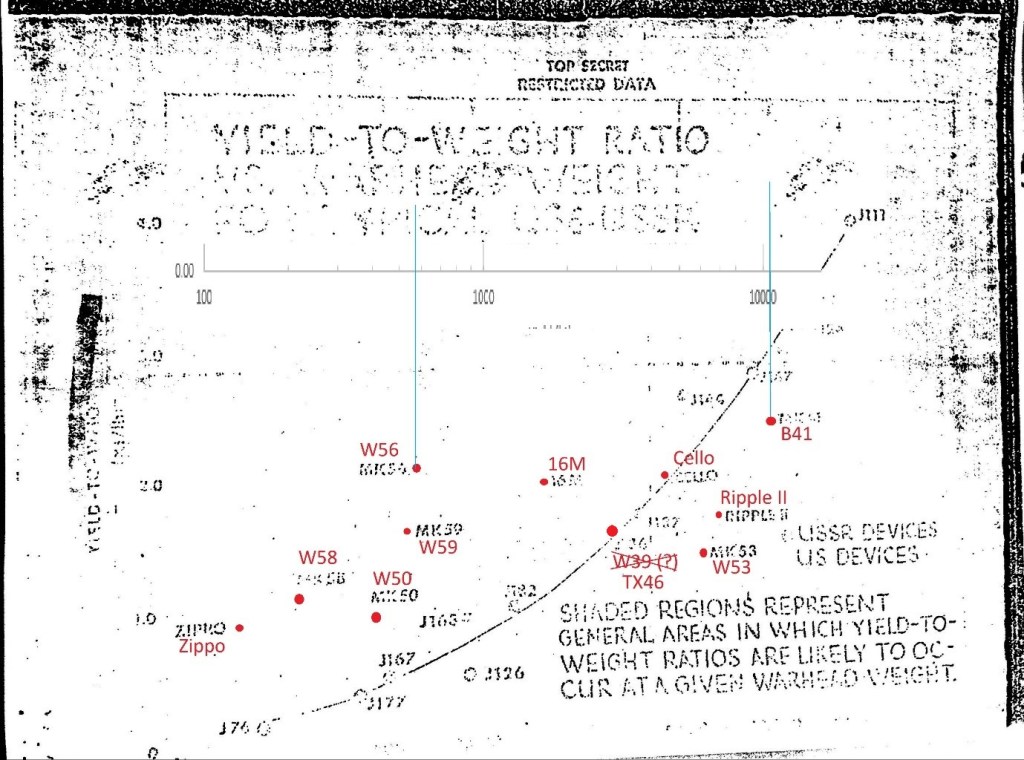
| Name | Weight (lb) | Yield to weight (kt/lb) | Weight (kg) | Yield to weight (kt/kg) | Yield (kt) |
| Zippo | 120 | 0.95 | 54.4 | 2.1 | 114 |
| W58 | 210 | 1.2 | 95.2 | 2.6 | 252 |
| W50 | 400 | 1 | 181.4 | 2.2 | 400 |
| W59 | 550 | 1.6 | 249.4 | 3.5 | 880 |
| W56 | 600 | 2.1 | 272.1 | 4.4 | 1260 |
| 16M | 1500 | 2 | 680.3 | 4.4 | 3000 |
| TX46 | 3000 | 1.7 | 1360.5 | 3.7 | 5100 |
| W53 | 6000 | 1.5 | 2721.0 | 3.3 | 9000 |
| Cello | 4500 | 2.1 | 2040.8 | 4.6 | 9450 |
| Ripple II | 7000 | 1.75 | 3174.5 | 3.9 | 12250 |
| B41 | 10000 | 2.5 | 4535.0 | 5.5 | 25000 |
This isn’t perfect given how unreadable the graph is. In some cases I have estimated where the dots go based on the location of other dots. The TX-46 is a particular nuisance and makes me wonder if it’s actually a Soviet test.
Some thoughts:
- Zippo is probably the 100 lb/ 100 kt concept investigated in the early 1960s.
- W58 weight may be sans RB. The same goes for the W56 and W59, which may throw scale calibration off.
- 6,000 lb fits the W53 warhead while the B53 bomb is more than 2,500 lb heavier due to the need for laydown equipment. At 6,000 lb, the 3.3 kt/kg YtW ratio produces the expected 9,000 kt yield.
- Tested yield of Ripple II was either 8,000 or 10,000 kt, which puts the yield here a little high.
 Super Octopus
5 responses to “Analysis of 1963 DCI Briefing to Joint Chiefs of Staff”
[…] implosion weapon should be capable of similar yields, but I am sceptical of the claim. For example, 1963 DCI Briefing to Joint Chiefs of Staff describes the 1958 developed 8-inch howitzer yield as being 1.9 kt, with 1961 and 62 developments […]
LikeLike
[…] upper yield estimate might come from the DCI Briefing to Joint Chiefs of Staff which I have previously discussed. In it, they estimate that a 450 kg (1000 lb) warhead with a yield of 2 Mt could be produced for […]
LikeLike
[…] is the W52 warhead for the Sergeant missile. In a 1962 declassified report which I discussed here, the W52 is described as having yields of 40 and 150 kt, similar to that mentioned previously. […]
LikeLike
I think the 1700lb mortar probably refers to the Soviet 420mm-calibre 2B1 Oka.
LikeLike
[…] Bluegill Triple Prime and Kingfish are often cited as being 400 kt, but as I showed here, the devices tested were actually the 200 kt version of the W50. The W49 device is a W28 warhead […]
LikeLike